Smart batteries have been used in portable and professional equipment since the mid-1990s, but the value of their embedded data is still often underused. Many organizations replace packs by age, date stamp, or fixed maintenance interval, even though two batteries of the same model and age can have very different usable capacity.
A smart battery can report more than whether it is full or empty. Depending on pack design and communication support, it may contain charge level, estimated capacity, serial number, manufacturing date, age, calibration status, and service history. The challenge is turning that information into a practical decision: is this battery ready for service, should it be charged, should it be tested further, or should it be removed from use?
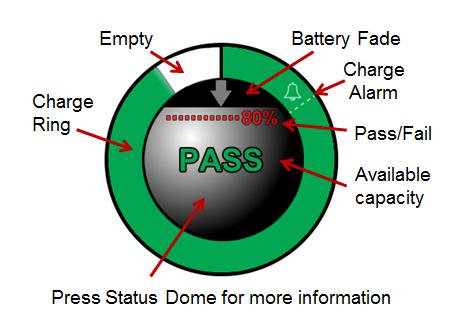
Cadex described one approach with the Battery Parser, a tool that communicates with a smart battery and presents a visual state-of-function view using a Fishbowl icon. The idea is not simply to read a fuel gauge, but to combine charge and battery condition into a clearer operating status. That distinction matters in medical equipment, field operations, drones, robots, and any battery fleet where a pack that appears fully charged may still provide less runtime than expected.
Why Smart Battery Data Needs Better Interpretation
The early promise of the smart battery was that the pack would not be a passive energy container. It would carry electronic memory and communication capability so host equipment, chargers, and service tools could make better decisions. In practice, many maintenance programs still rely on simple replacement rules.
A date-based rule is easy to administer, but technically blunt. A battery may be retired while it still has enough capacity for the application, or it may remain in service after its runtime has become inadequate. Calendar age is only one part of battery aging. Actual useful life depends on factors such as:
- number and depth of discharge cycles;
- time spent at high state-of-charge;
- storage temperature and operating temperature;
- charge method and charge termination behavior;
- load profile and peak current demand;
- cell chemistry, pack design, and protection electronics;
- calibration quality of the internal fuel gauge.
The supplied reference treats a five-year life expectancy for Li-ion as a useful context point, not as a universal guarantee. Some packs may remain serviceable beyond a nominal age threshold if lightly used and properly stored. Others may lose acceptable runtime earlier because of heavy cycling, heat exposure, or demanding loads.
This is why smart battery data needs interpretation rather than mere collection. A serial number, manufacturing date, and charge percentage are useful, but they do not automatically answer the operational question. The more valuable output is state-of-function: a service-oriented view of whether the battery can perform the task expected of it.
Better interpretation also reduces false confidence. A battery may pass a quick visual inspection and show full charge, yet have reduced capacity because of battery fade. Conversely, a pack flagged only by age may still have adequate measured capacity for a lower-demand role. A data-driven system can support graded decisions instead of a single age-based discard rule.
Reading State-of-Function with the Battery Parser
The Battery Parser by Cadex is presented as a tool for establishing communication between the user and the smart battery. It retrieves intrinsic battery data and converts it into a state-of-function display. The goal is to make technical battery information readable for routine service decisions while preserving the distinction between charge level and battery condition.
In this model, state-of-function is a practical readiness assessment. It can indicate that a pack is acceptable for use, needs charging, should be checked, or has failed the selected service criteria. This differs from simply reporting voltage or a fuel-gauge percentage.
Source: Battery University

The reference describes a Fishbowl icon with two main visual elements:
- Charge Ring: indicates state-of-charge, or how full the battery is at that moment.
- Status Dome: displays service messages such as PASS, CHARGE, CHECK, and FAIL.
The Charge Ring answers a familiar question: does the battery need energy before use? The Status Dome answers a broader question: is the battery functionally suitable? A battery can require charging but still be healthy. Another can be fully charged but close to a fail criterion if capacity has faded too far.
The Status Dome also represents energy storage capability over time. As a battery ages and is used, capacity fade moves it closer to a pass/fail boundary. This visual treatment is useful because capacity fade is gradual. Batteries rarely move from good to unusable in one step; they normally decline across many cycles and storage periods.
The PASS, CHARGE, CHECK, and FAIL messages support different service responses:
- PASS means the pack meets the selected condition for use.
- CHARGE means the pack lacks sufficient charge but is not necessarily unhealthy.
- CHECK suggests the pack needs additional evaluation or attention.
- FAIL means the pack does not meet the applicable service criterion.
The specific criterion behind these messages depends on the analyzer, the battery, the application, and the policy configured by the operator. The engineering principle is that battery information should be interpreted against the intended task. A pack unsuitable for a high-criticality or high-runtime application may still be usable in a lower-demand role if the organization permits graded deployment.
Separating Charge Level from Usable Capacity
State-of-charge and usable capacity are often confused because both are commonly expressed as percentages. They describe different things.
State-of-charge (SoC) describes how full the battery is relative to its present usable capacity. If the fuel gauge reads 100 percent after charging, it means the battery is full according to its current estimate. It does not necessarily mean the battery can still store the same energy it could when new.
Capacity or state-of-health (SoH) describes how much energy the battery can still store compared with its rated or original condition. A battery that has lost a substantial portion of its capacity can still charge to 100 percent, but that 100 percent represents a smaller energy reserve.
For operators, this distinction is critical. A fully charged weak battery may look ready while delivering much shorter runtime. This is especially problematic in equipment that has long idle periods followed by urgent use, or in missions where replacement during operation is difficult.
A simple example illustrates the issue. If a pack originally supported a device for a full shift but now has only a reduced fraction of its original capacity, the display may still reach 100 percent after charging. The charge indicator says the remaining capacity is full; it does not say the remaining capacity is sufficient.
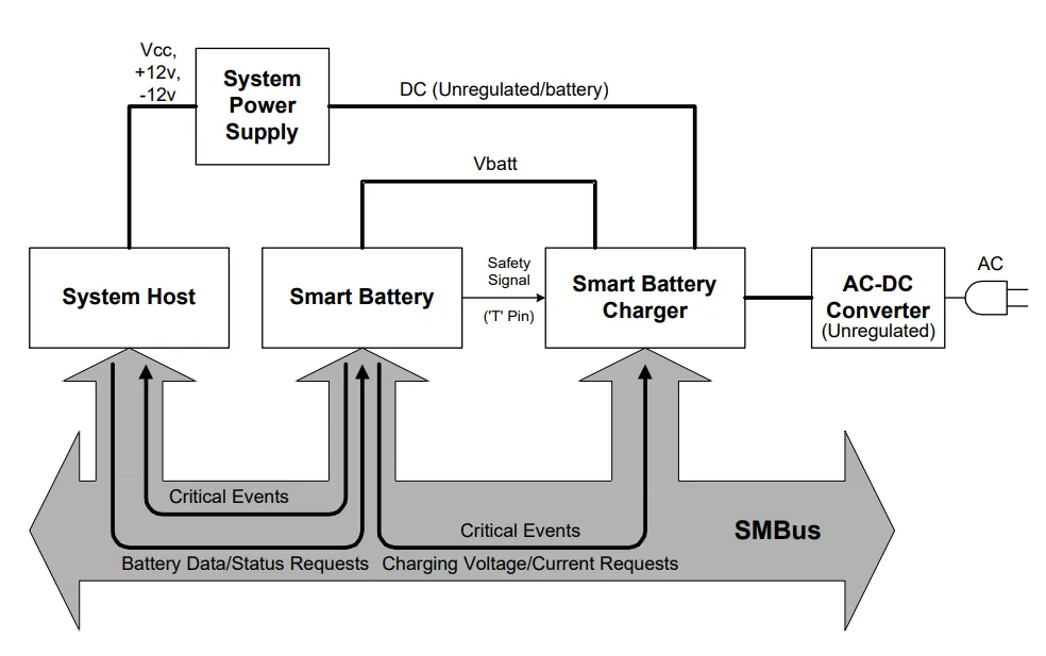
Smart battery communication can help expose this hidden condition. SMBus is a common protocol for portable smart batteries. Where supported by the battery and reading equipment, SMBus data may include delivered energy, estimated capacity, battery age, calibration status, cell balance information, serial number, and other pack characteristics.
Source: Battery University

The supplied research notes that SMBus-based readings can be available quickly and may estimate capacity close to values derived from a full discharge cycle under suitable conditions. However, capacity estimate accuracy should not be treated as fixed. It depends on protocol support, calibration quality, operating conditions, the battery model, and the analyzer method.
This is why practical battery assessment should avoid relying on a single number without context. A robust service view considers at least:
- present state-of-charge;
- estimated or measured capacity;
- battery age and manufacturing date;
- recent test or charge history;
- calibration status where available;
- application runtime requirement;
- safety and criticality of the equipment.
When charge and capacity are separated correctly, maintenance decisions become more accurate. Operators can charge batteries that are merely depleted, test batteries that are uncertain, and retire batteries that no longer meet usable capacity requirements.
Using Battery Data for Fleet Management
The value of smart battery data increases when it is collected across an entire fleet. A single battery reading helps with one immediate decision. A database of readings helps manage replacement planning, equipment readiness, inventory, and maintenance workload.
The reference describes storing battery test results in a cloud-based database to provide an overview of the fleet by location, application, performance, and service requirements. Smart batteries can supply identifiers such as serial number and manufacturing date, allowing records to be tied to specific packs rather than anonymous inventory counts.
Useful fleet attributes may include:
- serial number or pack identifier;
- manufacturing date or commissioning date;
- assigned location;
- application or device type;
- latest state-of-charge;
- latest capacity estimate or measured capacity;
- service status such as pass, charge, check, or fail;
- charger or analyzer used for the last update;
- date and result of the last test.
With this information, a battery manager can search for packs that meet selected service conditions. For example, an organization may flag packs below 80 percent capacity or packs older than a selected age. These are configurable policy thresholds, not universal laws. A critical medical device, field radio, drone, or robot may justify a more conservative limit than a low-risk application.
A cloud-connected database also helps avoid two common maintenance problems. First, it reduces premature replacement by identifying batteries that still meet capacity requirements. Second, it reduces unexpected failures by identifying weak batteries before they are assigned to demanding service.
Battery assessment is especially effective when integrated into normal charging workflows. If the charger can read the smart battery, update capacity information, and send the result to a shared record, each charge event becomes an opportunity to refresh the fleet database. The user does not need a separate logistics process for every battery check.
The reference also notes that a quick insertion into a charger or analyzer can reveal battery status before use. This is valuable in shift-based operations, emergency response, field deployment, and mobile equipment staging. Instead of assuming that all batteries in a charged bin are functionally equal, operators can select packs based on both charge and condition.
Wireless connectivity and access from a PC or smartphone can reduce manual record keeping. The technical benefit is not the wireless link itself, but the ability to keep records current with less human effort. When each charge or analysis updates the record, the fleet view becomes more accurate and easier to maintain.
Operational Examples in Healthcare and Military Use
Healthcare environments are a strong example of why state-of-function matters. Medical equipment often depends on batteries that may spend much of their life waiting for use. A battery that fails early or delivers short runtime can affect equipment availability, while replacing every battery prematurely increases operating cost.
The reference describes hospital savings from using battery analyzers and data-driven replacement rather than replacing batteries too early. The supplied material does not provide a verified savings amount for publication here, so the important point is the mechanism: measured condition can separate batteries that still meet service criteria from batteries that need replacement.
In a healthcare battery program, smart battery data can support several practical tasks:
- identifying weak packs before they are installed in clinical equipment;
- confirming that stored batteries are charged and serviceable;
- assigning newer or stronger batteries to more critical devices;
- documenting battery condition for maintenance records;
- reducing waste from age-only replacement rules.
The same logic applies in military and field operations, where battery energy directly affects mission planning. A team carrying battery-powered equipment needs confidence not only that packs are charged, but that they can deliver the expected energy under the planned load. Knowing available performance helps plan around the actual energy source rather than assumed nominal capacity.
The supplied material references military use but does not provide verified numerical details for battery weight, mission duration, or quantities. Without verified figures, those specifics should not be treated as factual. The general engineering point remains valid: when battery status is known before deployment, operators can reduce unscheduled events and plan around realistic energy availability.
This is particularly important where spare batteries add burden, charging opportunities are limited, or equipment downtime has serious consequences. A smart battery fleet system cannot eliminate all field failures, but it can reduce avoidable failures caused by poor visibility into capacity fade and service condition.
Extending Smart Battery Analysis to Chargers, Drones, Robots, and Connected Systems
The reference argues that battery maintenance using parser-style data is best placed in the charger. This is practical because the charger is already where batteries regularly connect to infrastructure. If the charger can read the smart battery, display condition, update capacity information, and synchronize records, assessment becomes part of normal operation rather than an extra task.
A charger-based system can show capacity during each charge or provide a quick status check before use. For fleet users, this approach creates a continuous feedback loop:
- The battery is inserted into the charger or analyzer.
- The charger reads supported smart battery data.
- The system interprets state-of-charge and condition.
- The result is displayed locally and, if connected, uploaded to the fleet record.
- The updated record supports replacement planning and battery assignment.
Drones and robots are natural extensions of this approach. Their mission endurance depends on both present charge and true usable capacity. A drone battery that reports full charge but has reduced capacity may shorten flight time. A mobile robot with a degraded pack may fail to complete a route or return to a docking station with less margin than expected.
In these applications, battery information must be interpreted before the mission begins. The practical question is not only whether the battery is charged, but whether it can support the planned duty cycle. For autonomous systems, battery condition can influence route planning, payload selection, reserve energy margins, and maintenance scheduling.
Connected chargers and cloud updates also support collective battery management. When each charge event updates the battery file, managers gain a moving view of fleet condition. Packs can be rotated, retired, reassigned, or tested based on recent data rather than assumptions.
Modern smart battery systems may use several communication and processing methods depending on complexity. Portable batteries commonly use SMBus. Larger or more complex systems may use CAN or other links. Connected systems may include IoT-style data transfer, preprocessing of measured voltage, current, temperature, and impedance signals, and state-estimation methods for charge, health, and remaining useful life.
Advanced analytics and machine-learning methods are increasingly discussed for complex battery systems, especially where large volumes of operating data are available. For the practical smart battery fleet, however, the foundation remains simpler: read the available battery data, distinguish charge from capacity, apply service thresholds appropriate to the application, and keep records current.
Smart battery data is most valuable when it changes decisions. A fuel gauge alone can say that a battery is full. A state-of-function approach can say whether that full battery is ready, needs attention, or should be removed from service. That is the difference between storing data and using it for reliable battery operation.
References
- Battery University | BU-604: How to Process Data from a “Smart”…. (n.d.). http://www.batteryuniversity.com/article/bu-604-how-to-process-data-from-a-smart-battery
- A Self-Teaching Introduction to Battery Energy Storage. (n.d.). https://www.linkedin.com/pulse/self-teaching-introduction-battery-energy-storage-erin-shaw
- BU-909: Battery Test Equipment. (n.d.). http://www.batteryuniversity.com/article/bu-909-battery-test-equipment
- A Self-Teaching Introduction to Battery Energy Storage. (n.d.). https://medium.com/@erin_70159/a-self-teaching-introduction-to-battery-energy-storage-16319d8a74e6
- Battery University | BU-909a: Processing Data from a “Smart” Battery. (n.d.). http://www.batteryuniversity.com/article/bu-909a-processing-data-from-a-smart-battery
- How to Extract and Process Data from a Smart Battery. (n.d.). https://www.large-battery.com/blog/how-to-process-data-from-a-smart-battery-extraction-analysis
- US11658350B2 - Smart battery management systems - Google Patents. (n.d.). https://patents.google.com/patent/US11658350B2/en
- Frontiers | AI/ML enabled smart battery management systems in electric vehicles. (n.d.). https://www.frontiersin.org/journals/batteries-and-electrochemistry/articles/10.3389/fbael.2026.1883201/full
- Data Science. Battery data analysis. : r/askmath. (n.d.). https://www.reddit.com/r/askmath/comments/1rayrpe/data_science_battery_data_analysis
- Smart Batteries — Plane documentation. (n.d.). https://ardupilot.org/plane/docs/common-smart-battery-landingpage.html