Nickel-cadmium (NiCd) batteries were widely associated with the so-called memory effect, a loss of usable voltage and capacity after repeated shallow cycling or prolonged overcharge. The term became especially common during the nickel-cadmium era of the 1970s and 1980s. Newer battery chemistries are often advertised as memory-free, but that phrase does not mean that charging and discharge practices can be ignored. Nickel-metal hydride (NiMH) batteries are less susceptible to classic NiCd memory behavior, yet they can still show voltage depression and performance loss when misused.
In NiCd batteries, the problem is closely associated with changes in the active material and the formation of larger crystalline structures. Periodic controlled discharge, known as exercise, can help prevent this condition. Batteries that have been neglected for longer periods may require a slower and deeper corrective discharge called recondition. These procedures must be performed with suitable equipment and within the limits specified for the particular battery.
Memory Effect and Crystalline Formation in NiCd Batteries
The original term memory effect referred to cyclic memory. A NiCd battery subjected repeatedly to similar discharge conditions could appear to retain the point at which previous discharges ended. When additional energy was demanded beyond that point, the cell voltage could fall abruptly, making the battery appear to have lost capacity.
The effect was associated particularly with repeated shallow discharge and subsequent recharge, as well as with prolonged overcharge. In practical use, however, several different aging and performance mechanisms were often grouped under the single label of memory. A battery showing reduced runtime may instead have increased self-discharge, loss of active material, internal leakage, poor cell matching, or another fault.
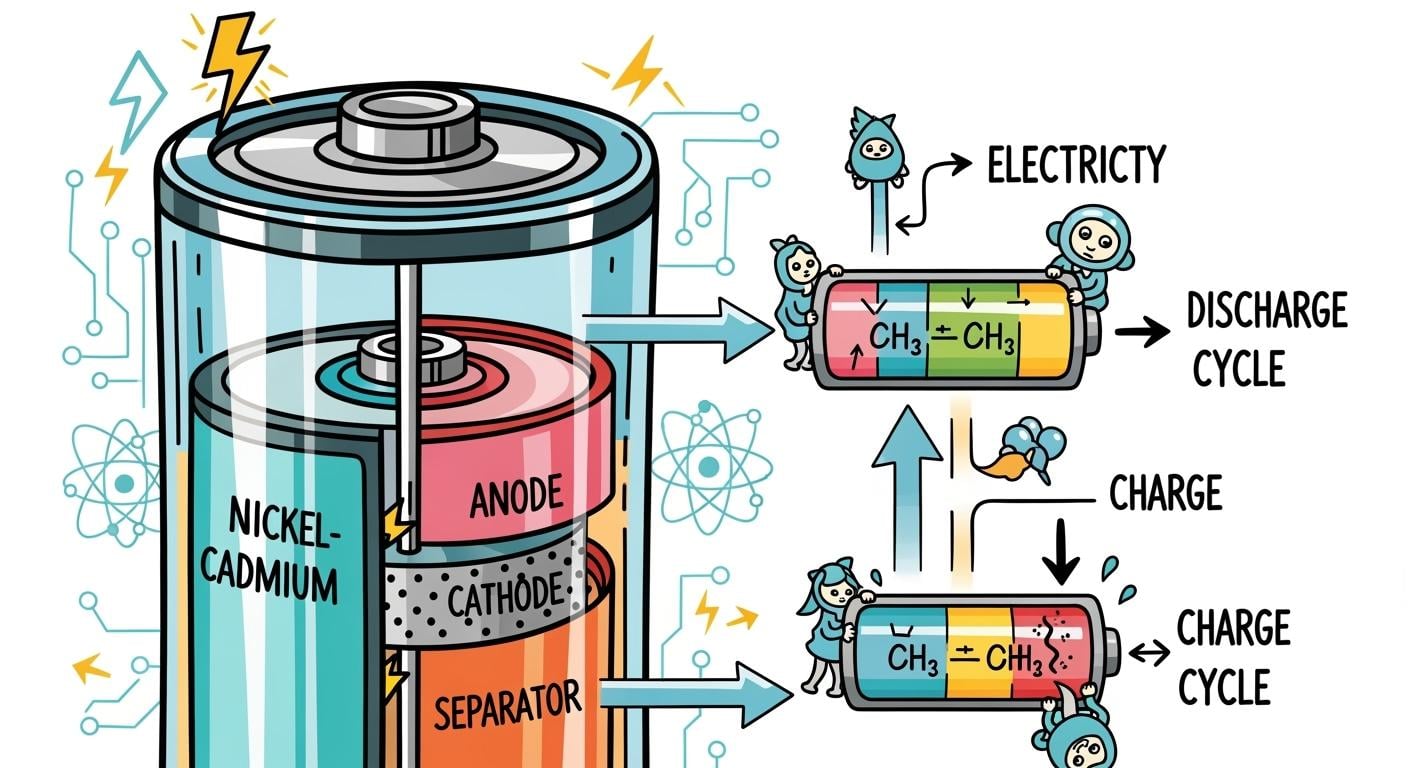
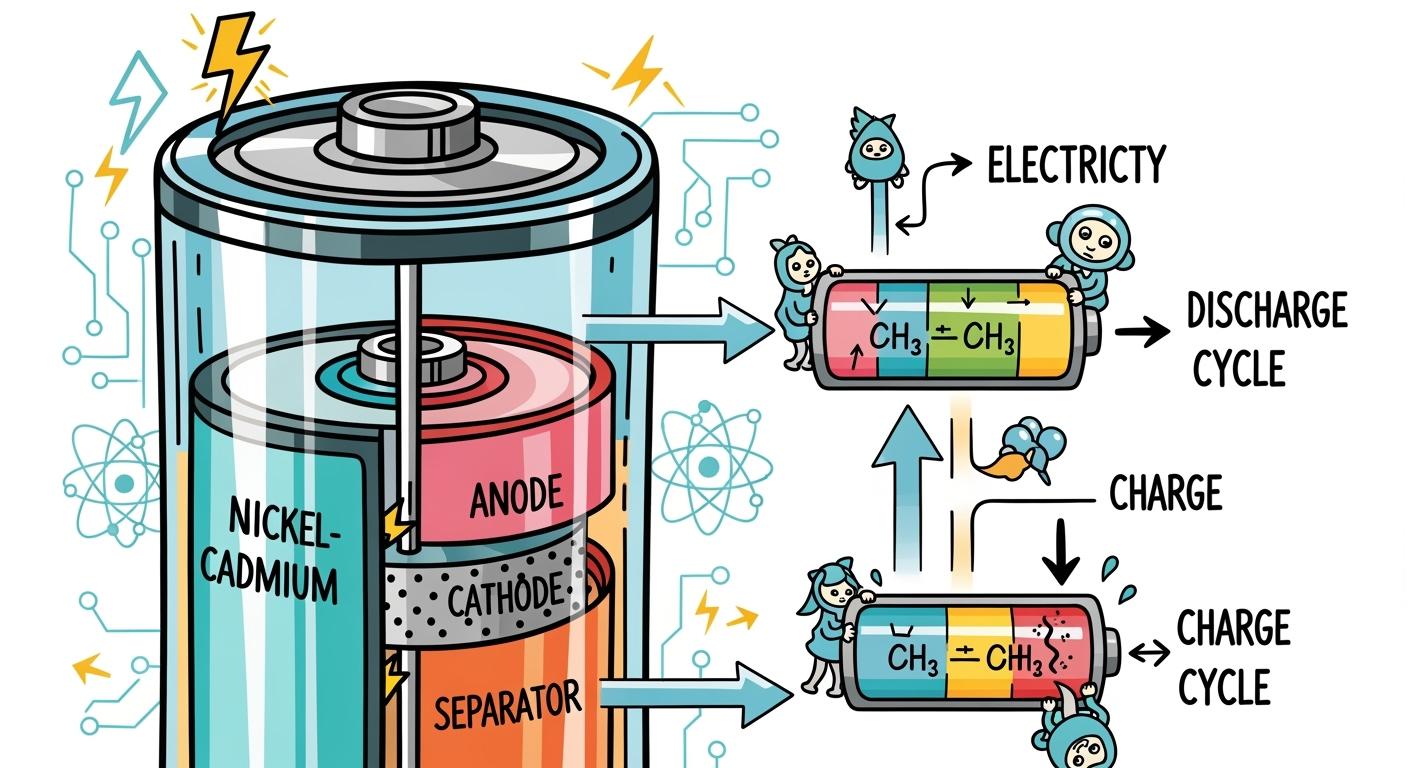
Crystalline formation is one important mechanism in affected NiCd cells. If a battery remains on a charger for days, or is repeatedly recharged without a periodic full discharge, the active material can develop harder, larger crystals. These structures reduce the effective surface area of the electrode and can increase the battery’s apparent internal resistance. The result may be reduced capacity, voltage depression under load, and an abrupt voltage drop before the battery has delivered its expected energy.
A simplified comparison is useful:
| Anode condition | Typical behavior |
|---|---|
| Normal | Active material has a relatively usable structure and the cell supplies its expected voltage and capacity. |
| Crystal-affected | Larger crystalline formations limit effective active material, producing voltage depression and reduced usable capacity. |
| Restored | A suitable discharge and charge process breaks down or reduces the problematic formation, improving performance when no other damage is present. |
A pulse charge may help reduce some memory-like behavior, and pulse or reverse-load methods can improve charge acceptance in certain nickel-based charging systems. However, a complete discharge cycle is generally more effective for reversing cyclic memory than relying on pulse charging alone. Restoration is not guaranteed: a battery with damaged separators, severe capacity loss, high self-discharge, or an internally shorted cell may not recover through cycling.
Source: Battery University
The voltage values used for maintenance are specified per cell, not per battery pack. A pack containing multiple cells therefore reaches the relevant voltage at a multiple of the individual-cell value. Discharge equipment must also account for cell imbalance. One weak cell can reach a low voltage before the rest of the pack, so a pack-level voltage reading does not by itself prove that every cell has been discharged safely.
NiCd and NiMH: How Susceptibility to Memory Differs
NiMH was introduced in part as a way to reduce some of the practical disadvantages associated with NiCd. It is generally less susceptible to the classic, pronounced memory behavior of NiCd, but it is not entirely immune to memory-like voltage depression or degradation caused by unsuitable charging and usage.
The difference should be understood as one of degree rather than an absolute divide. NiCd is more strongly associated with crystalline growth and cyclic memory under repeated shallow cycling and overcharge. NiMH is less prone to the same form of behavior, but repeated partial cycling, elevated temperature, overcharge, and prolonged storage can still reduce usable performance.
The phrase memory-free is therefore best treated cautiously. It commonly describes a chemistry that is less affected by the classic NiCd phenomenon, not a battery that can be charged indefinitely or discharged without regard to operating limits. NiMH cells still require an appropriate charger, suitable termination control, and protection against excessive heat and overcharge.
Maintenance practices must match the chemistry. A routine NiCd exercise cycle may be appropriate for a NiCd battery designed for that procedure, while routinely applying deep discharge to a NiMH battery can create unnecessary wear. The battery manufacturer or equipment documentation should take priority over a generic cycling schedule.
Exercise and Recondition Cycles for Nickel Batteries
Exercise is a periodic discharge-and-charge maintenance cycle used mainly with NiCd batteries. Its purpose is to reduce the likelihood that repeated shallow cycling or continuous charging will allow crystalline formations to become established. A typical interval is about every 1–3 months, although the correct interval depends on the battery design, application, charger, duty cycle, and manufacturer instructions.
For routine exercise, the battery is discharged to approximately 1 volt per cell and then fully recharged using an appropriate nickel-battery charging method. This is a controlled maintenance discharge, not an instruction to short-circuit the battery or to continue discharging an unmonitored pack until the voltage reaches zero.
Over-exercising should be avoided. Every discharge-and-charge cycle contributes some wear, so cycling a healthy battery more often than necessary can reduce service life rather than extend it. Exercise is intended to address a known maintenance need, not to provide a universal cure for every weak battery.
If exercise is omitted for approximately six months or longer, crystalline formations can become more firmly established. In that case, a normal discharge to 1 volt per cell may no longer be sufficient. A battery analyzer or other suitable equipment may offer a recondition function.
Recondition is a slower, deeper corrective discharge. It commonly takes the cell to about 0.4 volts per cell or lower, with the discharge current kept low. Test information cited for NiCd cells indicates that the voltage must fall to at least about 0.6 volts per cell to break up more resistant crystalline formations. The lower recondition endpoint is therefore not equivalent to a routine exercise endpoint.
The low-current requirement is important. NiCd cells have limited tolerance for cell reversal. In a series battery, one weak cell may become fully discharged before the others and then be driven into reverse polarity by the continuing discharge current. Excessive or uncontrolled reversal can cause permanent damage. Deep corrective discharge should therefore be performed only with equipment that controls current and monitors the battery appropriately.
A practical maintenance sequence is:
- Inspect the battery and confirm that it is suitable for cycling.
- Use a charger or battery analyzer designed for the battery chemistry and configuration.
- Perform a controlled discharge to about 1 volt per cell for routine NiCd exercise.
- Recharge using the approved charging process.
- Measure capacity or operating performance where the equipment supports it.
- If the battery remains affected and the manufacturer permits it, use a controlled low-current recondition cycle.
- Stop cycling if the battery overheats, leaks, swells, develops abnormal self-discharge, or fails testing.
A recondition cycle may restore capacity that was hidden by hard crystalline formation, but it cannot reverse every form of aging. If several cycles produce little improvement, replacement or specialist evaluation may be more appropriate than continued deep discharge.
NiCd Battery Maintenance in Aviation
NiCd batteries remain relevant in some aircraft applications because their operating characteristics and established maintenance procedures can suit demanding service conditions. Their continued use does not mean that generic consumer battery procedures are appropriate for aircraft equipment.
Aviation maintenance commonly involves controlled charging, capacity checks, inspection, and scheduled discharge or conditioning procedures. The purpose of a capacity check is to establish whether the battery can deliver the required energy under a defined test procedure, rather than relying only on its open-circuit voltage or the fact that it accepts a charge.
Typical maintenance activities may include:
- checking the battery condition, terminals, connectors, and enclosure;
- using an approved charger with the correct charging profile;
- inspecting for leakage, corrosion, overheating, or physical damage;
- performing scheduled discharge, conditioning, or capacity tests;
- recording test results and identifying weak or mismatched cells; and
- removing batteries that fail the applicable service limits.
Aircraft batteries must be maintained according to the aircraft maintenance manual, battery manufacturer’s instructions, and other approved maintenance documentation. The discharge endpoints, current, charging method, test interval, and acceptance criteria can vary with the battery and aircraft installation. A procedure suitable for a small consumer NiCd pack must not be transferred to an aircraft battery without authorization.
Deep reconditioning is particularly unsuitable as an improvised field procedure. It can expose weak cells to reversal, create heat, or produce a result that does not satisfy the aircraft’s required capacity or reliability criteria. Aviation technicians should use approved test equipment and document the work as required by the applicable maintenance system.
Care Guidance and Further Resources
Nickel-based battery life is prolonged by matching the maintenance method to the chemistry and application. For NiCd batteries, avoid leaving the battery on an unsuitable charger for prolonged periods, use periodic exercise when specified, and do not replace a controlled maintenance cycle with uncontrolled deep discharge. Exercise and recondition are different procedures: exercise is a routine discharge to approximately 1 volt per cell, while recondition is a slower corrective discharge that may reach about 0.4 volts per cell.
Do not attempt restoration on a battery that is leaking, physically damaged, excessively hot, or showing signs of an internal fault. Use a charger or battery analyzer designed for nickel-based batteries, and follow the equipment instructions for cell count, current, discharge endpoint, and recharge sequence.
For aircraft batteries, approved aviation documentation always takes precedence over general battery guidance. For other applications, useful follow-up topics include nickel-based battery charging, safe discharge limits, battery capacity testing, battery analyzer operation, and methods for distinguishing memory-like voltage depression from permanent capacity loss.
References
- Battery University | BU-807: How to Restore Nickel-based Batteries. (n.d.). http://www.batteryuniversity.com/article/bu-807-how-to-restore-nickel-based-batteries
- Battery University | BU-807: How to Restore Nickel-based Batteries. (n.d.). https://www.batteryuniversity.com/article/bu-807-how-to-restore-nickel-based-batteries
- Battery University | BU-807: How to Restore Nickel-based Batteries. (n.d.). https://batteryuniversity.com/article/how-to-restore-nickel-based-batteries
- Battery University | BU-203: Nickel-based Batteries. (n.d.). https://batteryuniversity.com/article/bu-203-nickel-based-batteries
- BU-807: How to Restore Nickel-based Batteries. (n.d.). https://batteryuniversity.com/article/bu-807-how-to-restore-nickel-based-batteries
- Battery University | BU-215: Summary Table of Nickel-based Batteries. (n.d.). https://batteryuniversity.com/article/bu-215-summary-table-of-nickel-based-batteries
- Battery University | BU-407: Charging Nickel-cadmium. (n.d.). http://www.batteryuniversity.com/article/bu-407-charging-nickel-cadmium
- Nickel-based Batteries Information - WeCanFigureThisOut.org. (n.d.). https://wecanfigurethisout.org/ENERGY/Web_notes/Electrochemical/Batteries_and_Fuel_Cells_Supporting_Files/Nickel-based%20Batteries%20Information%20%E2%80%93%20Battery%20University.pdf
- Battery University | BU-407: Charging Nickel-cadmium. (n.d.). https://batteryuniversity.com/article/charging-nickel-based-batteries
- Battery University | BU-203: Nickel-based Batteries. (n.d.). http://www.batteryuniversity.com/article/bu-203-nickel-based-batteries