Lithium batteries move through air cargo networks in phones, laptops, medical devices, sensors, instruments, and replacement packs. They are regulated dangerous goods because stored electrical energy, flammable electrolyte, short circuits, damage, and thermal runaway can create transport hazards.
Air shipment rules divide lithium batteries by chemistry and configuration. Rechargeable lithium-ion cells and batteries are regulated separately from generally non-rechargeable lithium-metal cells and batteries. A battery shipped alone is treated differently from one packed with equipment or installed in equipment. Those distinctions determine the UN number, packing instruction, labels, documents, aircraft limits, and state-of-charge requirements.
This article summarizes the practical structure of IATA lithium battery air-shipping rules. It is not a substitute for the current IATA Dangerous Goods Regulations, ICAO Technical Instructions, national hazardous-materials regulations, or airline operator variations. Battery transport rules change frequently, so the current edition must be checked before a shipment is offered to an air carrier.
Before Shipping: Battery Type, UN 38.3, and IATA DGR Scope
Lithium batteries are dangerous goods for air transport. In routine commercial shipment, lithium cells and batteries must have passed the applicable UN 38.3 tests in the UN Manual of Tests and Criteria before transport. UN 38.3 addresses transport stresses such as altitude simulation, thermal cycling, vibration, shock, external short circuit, impact or crush, overcharge, and forced discharge, depending on cell or battery type.
The first compliance step is identifying the battery correctly:
| Battery type and configuration | Typical UN number | Typical IATA packing instruction |
|---|---|---|
| Lithium-ion batteries shipped alone | UN 3480 | PI 965 |
| Lithium-ion batteries packed with equipment | UN 3481 | PI 966 |
| Lithium-ion batteries contained in equipment | UN 3481 | PI 967 |
| Lithium-metal batteries shipped alone | UN 3090 | PI 968 |
| Lithium-metal batteries packed with equipment | UN 3091 | PI 969 |
| Lithium-metal batteries contained in equipment | UN 3091 | PI 970 |
Lithium-ion batteries are rechargeable and common in consumer electronics, power tools, instruments, mobility products, and energy-storage equipment. Lithium-metal batteries are usually primary, non-rechargeable cells used in watches, sensors, memory backup, medical devices, and small consumer formats. They are treated more restrictively because lithium content and chemistry create a different risk profile.
IATA publishes the Dangerous Goods Regulations, which airlines use to classify, pack, mark, label, and document dangerous goods. The IATA DGR is based on ICAO requirements and incorporates airline operator variations. A shipment that appears compliant under a baseline packing instruction may still be refused if a carrier applies stricter limits or requires prior approval.
PI 965: Loose Lithium-Ion Cells and Battery Packs Shipped Alone
PI 965 applies to standalone lithium-ion cells and batteries assigned to UN 3480. These are batteries shipped by themselves, not packed with equipment and not installed in equipment. Examples include replacement packs, loose cylindrical cells, pouch cells, and battery modules offered as spare parts.
Standalone lithium-ion batteries are among the most restricted lithium battery air shipments. Beginning in 2022, IATA removed Section II provisions from PI 965. Small standalone lithium-ion battery shipments that previously may have moved under Section II are generally fully regulated under Section IB or Section IA, depending on shipment characteristics. Shippers should not rely on older Section II procedures for UN 3480 air shipments.
Standalone lithium-ion batteries are prohibited as cargo on passenger aircraft. When transported by air, compliant UN 3480 shipments are generally cargo aircraft only, subject to the current DGR, competent authority approvals where required, and carrier variations.
Core controls for PI 965 include:
- strong outer packaging suitable for the battery mass and configuration;
- inner packaging or cushioning that prevents movement and damage;
- terminal protection to prevent short circuits;
- separation from conductive materials and incompatible dangerous goods;
- compliance with applicable net quantity limits;
- Class 9 lithium battery hazard labeling and Cargo Aircraft Only labeling where required;
- a dangerous goods declaration and other transport documents when the shipment is fully regulated.
Section IA normally applies to larger or higher-quantity shipments and requires full dangerous-goods documentation and handling. Section IB is still regulated but is used for limited standalone battery shipments meeting applicable thresholds and conditions. Exact thresholds and package limits must be taken from the current IATA DGR tables.
Lithium Battery Marks, Labels, and Shipping Documents
Lithium battery hazard communication depends on the UN number, packing instruction, configuration, package quantity, and whether the shipment is fully regulated. The shipper must select the correct marks and labels before offering the package to an airline.
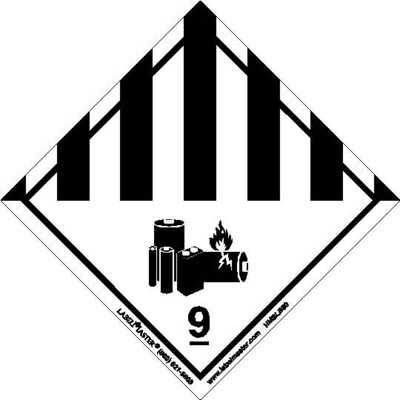
Source: Battery University

Common hazard-communication elements include:
- battery mark or lithium battery mark, where applicable to excepted or smaller battery shipments;
- Class 9 lithium battery hazard label for fully regulated lithium battery shipments;
- Cargo Aircraft Only label when the package is not permitted on passenger aircraft or exceeds passenger-aircraft limits;
- UN number, such as UN 3480, UN 3481, UN 3090, or UN 3091;
- proper shipping name, such as lithium ion batteries, lithium ion batteries packed with equipment, lithium metal batteries, or lithium metal batteries contained in equipment.
Older articles and packaging examples may refer to a CAUTION lithium battery label. Current requirements use updated lithium battery or battery mark terminology and standardized dangerous-goods labels. Recent IATA editions also broadened battery-mark terminology because additional battery types are being integrated into dangerous-goods rules. Old artwork, obsolete wording, or legacy labels should not be reused without checking the current DGR.
Documentation may include a Shipper’s Declaration for Dangerous Goods, air waybill statements, emergency response or handling information where applicable, and carrier-specific lithium battery forms. Fully regulated shipments normally require more complete documentation than smaller shipments qualifying for limited exceptions. Airlines and freight forwarders may also require acceptance checklists, prior booking information, or shipper certifications beyond the minimum regulatory text.
State-of-Charge Limits for Air Shipment
State of charge is a key safety control for lithium-ion air transport. A lower state of charge reduces stored electrical energy and can reduce the severity of a thermal runaway event if a cell is damaged, short-circuited, or exposed to heat. It does not remove the hazard, but it is an important risk-reduction layer.
Standalone lithium-ion cells and batteries shipped by air under UN 3480 are generally limited to no more than 30% state of charge unless an approval or exception applies. Shippers should have a practical method to set and verify state of charge and may need to document it. Verification can involve production controls, battery-management-system readings, open-circuit-voltage correlation, or other controlled procedures appropriate to the chemistry and pack design.
The 30% limit has historically applied most directly to standalone lithium-ion batteries shipped by air. Rules are expanding. IATA guidance for 2025 recommended broader use of 30% state of charge for lithium batteries shipped with equipment, in equipment, or in vehicles. For 2026, IATA rules introduce mandatory 30% state-of-charge limits for many lithium-ion cells and batteries packed with equipment under PI 966, with approval pathways for batteries that must move at a higher state of charge.
Exceptions require care. Certain medical, operationally necessary, or specially approved batteries may be allowed above 30% state of charge when competent authority approval is granted under the applicable conditions. Treat any above-limit shipment as a special case, not routine commerce.
General Air-Transport Rules and Passenger-Carry Limits
Across lithium battery packing instructions, several controls repeat. Cells and batteries must be protected from short circuit, movement, damage, and conditions that could cause dangerous heat generation. Equipment must be secured and protected against accidental activation. Manufacturers and shippers must comply with applicable quality-management and test-summary requirements associated with UN 38.3.
Damaged, defective, recalled, waste, and recycling batteries are not ordinary lithium battery shipments. They are subject to severe restrictions and are often forbidden by air unless a competent authority approval or specific regulatory pathway applies. A battery suspected of damage or internal fault should not be reclassified as a normal spare because its exterior appears intact.
Passenger rules are separate from commercial cargo rules but are often confused with them. Spare lithium batteries carried by passengers are typically restricted to carry-on baggage rather than checked baggage, because cabin crews can respond more quickly to smoke or overheating. Batteries installed in devices may be allowed under separate airline, security, and national rules. Airlines may impose stricter limits than baseline regulations, so passengers should check before traveling with spares, power banks, camera batteries, or medical-device batteries.
Special cases such as large batteries, prototypes, low-production batteries, or batteries requiring a higher state of charge may need approval from the State of Origin, State of Operator, or another competent authority. Carrier approval may also be needed before tendering the shipment.
PI 966 and PI 967: Lithium-Ion Batteries Packed With or Contained in Equipment
PI 966 and PI 967 cover lithium-ion batteries assigned to UN 3481. The distinction is important:
- PI 966 applies when lithium-ion cells or batteries are packed with equipment but not installed in it.
- PI 967 applies when lithium-ion cells or batteries are contained in equipment.
A spare battery packed in the same box as a device is not the same as a battery installed inside the device. Packaging, marking, quantity, and documentation requirements can differ.
For PI 966, the battery must be protected from short circuit and movement, and the equipment must be packed so it is not damaged by the battery or packaging. For PI 967, the equipment must be secured inside the package, the installed battery must be protected by equipment design or additional packaging, and the device must be protected against accidental activation. Switches, triggers, wireless functions, heating elements, or motor drives may require mechanical or electrical controls to prevent unintended operation.
Unlike standalone UN 3480 batteries, lithium-ion batteries packed with or contained in equipment may be allowed on passenger aircraft when the shipment complies with the applicable packing instruction. However, carrier variations may be stricter, and quantity limits or label requirements can still trigger cargo-aircraft-only handling.
A major current development concerns PI 966. In 2026, many lithium-ion cells and batteries packed with equipment must generally be offered for air transport at no more than 30% state of charge unless approvals apply. Shippers that previously shipped charged spare batteries with devices should review product configuration, charging process, documentation, and carrier acceptance requirements.
Additional Package, Overpack, and Training Requirements
Battery shipping compliance is not only a label exercise. Packages must be assembled so cells, batteries, and equipment remain safe during normal transport handling, including vibration, stacking, impacts, temperature variation, and movement through multiple carriers or freight terminals.
Important package and overpack controls include:
- complying with package and consignment limits in the applicable packing instruction;
- keeping required marks and labels visible, or reproducing them on the overpack;
- marking the overpack when required;
- avoiding combinations with incompatible dangerous goods;
- preventing batteries from shifting inside inner or outer packaging;
- protecting exposed terminals with caps, recessed designs, insulating tape, individual bags, or equivalent methods;
- preventing equipment from turning on during transport.
Training requirements depend on the role and shipment type. Employees who classify, pack, mark, label, document, offer, accept, load, or transport dangerous goods need training appropriate to their responsibilities. Fully regulated lithium battery shipments require more extensive dangerous-goods training and documentation than shipments moving under limited exceptions. Even under reduced requirements, personnel need enough instruction to recognize the battery type, apply the correct packing instruction, and avoid prohibited shipments.
Carrier acceptance checks may require package tests, lithium battery handling forms, documentation review, or shipper declarations. A freight forwarder may reject a package that lacks visible marks, has outdated labels, uses damaged packaging, or conflicts with airline variations.
PI 968: Loose Lithium-Metal Cells and Battery Packs Shipped Alone
PI 968 applies to standalone lithium-metal cells and batteries assigned to UN 3090. These are primary lithium batteries shipped without equipment. Common examples include lithium coin cells, cylindrical lithium primary cells, instrument batteries, memory-backup cells, sensor batteries, medical-device batteries, and consumer lithium AA, AAA, or 9V formats.
Lithium-metal batteries face tighter restrictions than lithium-ion batteries because regulation is based partly on lithium content and the chemistry’s risk profile. As with PI 965, IATA removed Section II provisions from PI 968 beginning in 2022. Standalone lithium-metal batteries shipped by air are therefore generally fully regulated under Section IB or Section IA rather than handled under old Section II procedures.
Standalone lithium-metal batteries are prohibited as cargo on passenger aircraft. When they move by air, they generally require cargo aircraft only and must comply with strict quantity, packaging, labeling, and documentation requirements.
PI 968 controls include:
- compliance with lithium content limits in the current DGR;
- strong outer packaging;
- separation and cushioning to prevent movement;
- terminal protection and short-circuit prevention;
- Class 9 lithium battery hazard label;
- Cargo Aircraft Only label where required;
- dangerous-goods documentation when required by the section used.
Because lithium-metal rules can be more restrictive and carrier acceptance narrower, shippers should verify airline variations before booking UN 3090 cargo.
PI 969 and PI 970: Lithium-Metal Batteries Packed With or Contained in Equipment
PI 969 and PI 970 cover lithium-metal batteries assigned to UN 3091:
- PI 969 applies when lithium-metal cells or batteries are packed with equipment.
- PI 970 applies when lithium-metal cells or batteries are contained in equipment.
The same configuration distinction used for lithium-ion batteries applies here. A loose primary cell packed beside a device is regulated differently from a cell installed in the device. Marking, labeling, documentation, and package limits depend on the exact configuration and quantity.
For lithium-metal batteries packed with equipment, the cells or batteries must be protected from short circuit and secured so they cannot shift or be damaged. For batteries contained in equipment, the device must protect the cell or battery and must be packed to prevent accidental operation. Equipment should be immobilized in the package to prevent damage during normal handling.
Lithium-metal batteries generally face tighter limits than comparable lithium-ion shipments. Air-transport restrictions may include passenger-aircraft limits, cargo-aircraft-only requirements, net quantity thresholds, and carrier-specific prohibitions or approvals. The Cargo Aircraft Only label is required when the shipment is not permitted on passenger aircraft or exceeds applicable passenger-aircraft limits.
Shipping Prototype, Low-Production, or Non-UN-Tested Batteries
Prototype and low-production lithium cells or batteries that have not completed UN 38.3 testing cannot be shipped as routine commercial batteries. Air transport is possible only under special conditions, normally with approval from the appropriate competent authority. Depending on the route and rules applied, approval may be required from the State of Origin, State of Operator, or another relevant authority.
In the United States, 49 CFR 173.185(e) provides a regulatory pathway for certain prototype or low-production lithium cells and batteries transported for testing. Conditions include special packaging, documentation, and controls designed to prevent short circuit, movement, accidental activation, and dangerous heat generation. Air shipment is generally restricted to cargo aircraft and must follow the approval conditions.
Prototype approval is different from permission to ship damaged, defective, recalled, waste, or recycling batteries. Those categories have separate and often stricter rules because the hazard is not merely incomplete testing; the battery may already be unsafe or its condition may be uncertain.
For engineering teams, the practical lesson is to plan transport compliance before building and distributing test batteries. Cell format, pack enclosure, terminals, state-of-charge controls, test status, packaging design, and documentation all affect whether an air shipment can be accepted. A prototype battery that is electrically functional but not transport-ready can delay testing, certification, and customer evaluation if its shipping pathway is not addressed early.
References
- Battery University | BU-704a: Shipping Lithium-based Batteries by Air. (n.d.). https://www.batteryuniversity.com/article/bu-704a-shipping-lithium-based-batteries-by-air
- How to ship lithium batteries by air—in 2022 and beyond - Labelmaster Blog. (n.d.). https://blog.labelmaster.com/how-to-ship-lithium-batteries-by-air-as-of-april-1-2016
- How to Ship Lithium-based Batteries by Air Safely and Legally. (n.d.). https://www.large-battery.com/blog/shipping-lithium-based-batteries-by-air-safely-legally
- Lithium Battery Shipping Rules Changed in 2026. Here’s Why Your Packaging Partner Should Know. | Novvia Group. (n.d.). https://novviagroup.com/post/lithium-battery-shipping-rules-changed-in-2026
- UN 38.3 Testing for Lithium Batteries. (n.d.). https://www.intertek.com/batteries/un-38-3-testing
- LITHIUM BATTERY GUIDE FOR SHIPPERS. (n.d.). https://www.phmsa.dot.gov/sites/phmsa.dot.gov/files/2024-11/Lithium-Battery-Guide-2024.pdf
- Safety Requirements for Transportation of Lithium Batteries. (n.d.). https://www.mdpi.com/1996-1073/10/6/793
- Shipping Lithium Batteries by Air in 2025. (n.d.). https://www.youtube.com/watch?v=N28XXiCOemc
- Batteries. (n.d.). https://www.iata.org/en/programs/cargo/dangerous-goods/lithium-batteries
- IATA’s Lithium Battery Shipping Regulations: An In-Depth Guide – VIABOX Official Package Forwarding Newsletter. (n.d.). https://pro.viabox.com/blog/general/iatas-lithium-battery-shipping-regulations-an-in-depth-guide