Smart batteries added a digital layer to rechargeable packs. The concept was introduced in 1994 by Intel and Duracell, and it changed the role of the battery from a passive energy source into a communicating subsystem. Instead of only accepting a charger algorithm from outside, a smart pack can report its condition, exchange data with a host, and in some architectures influence how charging is managed.
For portable equipment, medical devices, industrial tools, and other battery-powered systems, that data can be as important as the cells themselves. A host may depend on the battery for state-of-charge indication, remaining-runtime prediction, fault reporting, and service decisions. The difficulty is that a battery is both a chemical system and a digital estimate. The cells age continuously, while the fuel gauge must infer capacity and charge state from measurements that are imperfect and conditions that change.
Calibration is the process of bringing the digital estimate back into closer agreement with the chemical battery. Modern SMBus batteries with impedance tracking can update usable capacity during normal operation, reducing the need for frequent manual calibration. They do not, however, remove all error. Understanding what calibration can and cannot do is essential when interpreting state-of-charge, full charge capacity, and end-of-life behavior.
Why Smart SMBus Batteries Need Calibration
A conventional battery pack may provide terminals, protection electronics, and little else. A smart SMBus battery adds a communication interface and a fuel-gauge function. SMBus, the System Management Bus, allows the battery and host equipment to exchange standardized operating information. In practical terms, the host can ask the pack what it believes its present charge, capacity, voltage, current, temperature, and status are.
The smart battery performs several useful functions:
- State-of-charge reporting: It estimates how much usable charge remains and presents this to the host or user interface.
- Performance-data capture: It tracks information related to charge and discharge behavior, capacity, and battery condition.
- Anomaly detection: It can report abnormal operating conditions or data that indicate a battery or system problem.
- Host and charger coordination: In some systems, the battery does more than simply receive charge; it participates in how the host or charger manages the pack.
These functions depend on a digital model of a battery that is changing with use. The model may count charge entering and leaving the pack, observe voltage, apply temperature compensation, and compare present behavior with learned battery characteristics. Over time, small errors accumulate. Current measurement offsets, incomplete charge or discharge events, self-discharge, rest-state assumptions, temperature changes, and aging all contribute to drift between the displayed battery and the real electrochemical battery.
Calibration is required because the fuel gauge needs reference points. A battery may report 50% state of charge, but that value is only meaningful if the gauge has a realistic estimate of the pack’s present full usable capacity and remaining charge. If the gauge still assumes the battery can deliver nearly the same energy it delivered when new, while the cells have aged, the displayed state of charge and runtime estimate can become optimistic. Conversely, if the gauge underestimates usable capacity, the system may report low battery too early.
The purpose of calibration is not to improve the cells. It is to correct the information system around the cells. A well-calibrated smart battery gives the host a more believable relationship between indicated state of charge, actual remaining capacity, and expected shutdown point.
What a Manual Calibration Cycle Does
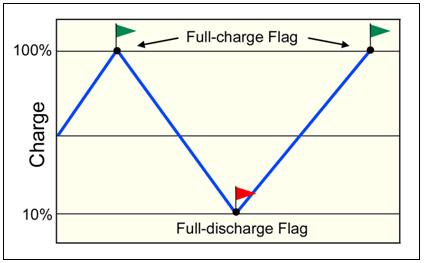
The traditional calibration method for a smart battery is a deliberate full discharge followed by a full charge, or a full charge followed by a controlled discharge and recharge, depending on the manufacturer’s procedure. The essential idea is to expose the fuel gauge to known reference conditions so it can reset or update internal flags, endpoints, and learned values.
In this context, a full discharge means a controlled discharge to the battery system’s allowed cutoff point, not forcing cells to zero volts. A full charge means charging according to the approved charge method until the pack reaches its normal full condition. For lithium-ion smart batteries, uncontrolled over-discharge or improvised charging can damage the pack or create unsafe conditions, so calibration should follow the equipment or battery manufacturer’s instructions.
A manual calibration cycle can improve the way the state-of-charge display behaves. Before calibration, the indicated percentage may fall nonlinearly, remain high for too long, drop suddenly near the end, or trigger shutdown while still showing apparent charge. After calibration, the displayed percentage is often more linear and more believable because the gauge has been re-synchronized with the battery’s observed behavior.
The effect is temporary. As the pack goes through normal partial charges, partial discharges, idle periods, and temperature variations, measurement and modeling errors begin to build again. The digital battery gradually drifts away from the chemical battery. How quickly this becomes noticeable depends on the battery design, fuel-gauge method, application profile, and depth of cycling.
It is also important to separate calibration from restoration. Calibration does not reverse chemical aging. It does not rebuild lost active material, reduce permanent internal resistance growth, or recover capacity that has been lost through normal wear. If a battery has aged from its original design capacity to a lower usable capacity, calibration can help the fuel gauge report that lower capacity accurately. It cannot make the pack behave like new.
For service work, this distinction matters. A battery that shows poor runtime after calibration may not be miscalibrated; it may simply have low usable capacity. Likewise, a battery that shuts down unexpectedly may have a fuel-gauge error, high internal resistance, a weak cell group, or a digital reporting problem. Calibration is one diagnostic and maintenance tool, not a universal repair.
How Impedance Tracking Updates Full Charge Capacity
Full Charge Capacity, often abbreviated FCC, is the fuel gauge’s estimate of how much charge the battery can presently store and deliver when full. It is not the same as design capacity. Design capacity is the nominal value assigned when the battery is new. FCC is the gauge’s current estimate of usable full capacity after aging, operating history, and learned behavior are considered.
As a battery ages, its usable capacity declines. Some of the original capacity becomes unavailable because of chemical and physical changes inside the cells. The fuel gauge must therefore update FCC if state-of-charge and runtime predictions are to remain credible. A gauge that keeps using the original design capacity after significant aging will overestimate remaining energy.
Impedance-tracking fuel gauges address this by learning from the battery during use. They monitor charge moving into or out of the battery and relate that measured charge movement to observed changes in state of charge. When the gauge can observe a meaningful state-of-charge change while measuring energy flow, it can refine its estimate of usable capacity. The same principle can apply during charge or discharge: known charge movement plus a change in estimated state of charge gives information about the total usable capacity.
The reference analogy is a glass. Imagine the battery as a glass that can no longer use all of its original volume. In the example, 20% of the glass is unusable capacity. The glass already contains 30% old fill, representing residual charge. A further 30% measured new fill is added. When the gauge observes that the glass has reached 80% state of charge, it can infer usable capacity from the residual content plus the measured added charge. The same logic can work in reverse by measuring charge removed during discharge.
Source: Battery University

This analogy is useful because it separates three ideas that are often confused:
- Unusable capacity: capacity lost or unavailable because the battery has aged or cannot deliver it under the present conditions.
- Residual charge: charge already present before the measured event begins.
- Measured charge transfer: charge added during charging or removed during discharging, which gives the fuel gauge new information.
Impedance tracking does not mean the pack knows everything instantly. Some systems need a learning cycle before the gauge can update key values with confidence. Rest periods may also be required because voltage behavior during rest can provide information that is not available while the battery is under load or charge. A battery in active use has voltage drops, recovery effects, and temperature influences that complicate direct interpretation.
In practical applications, impedance tracking can reduce the frequency of formal manual calibration because the battery keeps learning during normal operation. However, the quality of the update depends on the operating pattern. A battery that is always used in shallow cycles, never allowed to rest, or never reaches useful reference regions may have fewer opportunities to correct its FCC estimate.
How State of Charge Is Estimated and Why Errors Remain
State of charge is the fuel gauge’s estimate of the battery’s present charge relative to its present usable capacity. In a simple display, it appears as a percentage. Internally, the estimate is more complex. A smart battery may combine voltage measurement, temperature measurement, current integration, learned full charge capacity, internal resistance or impedance information, and model-based calculations.
No single measurement is sufficient in all conditions. Voltage alone can be misleading because the voltage of a rechargeable cell depends on chemistry, load current, temperature, recent history, and rest time. Current integration, often called coulomb counting, tracks charge flowing in and out, but it accumulates error if the current measurement has offset or scaling error. Temperature changes affect both cell behavior and usable capacity. Aging changes capacity and resistance. The fuel gauge must combine these inputs into an estimate that is useful to the host.
Smart batteries refine their estimates in several ways:
- During normal discharge, the gauge measures charge leaving the pack and compares behavior with its model.
- During normal charge, it measures charge entering the pack and observes whether the battery reaches expected full conditions.
- During rest periods, it may use relaxed voltage behavior to improve its estimate of state of charge or capacity.
- During deliberate calibration cycles, it can observe wider operating ranges and update reference points more completely.
Impedance tracking improves this process by allowing the battery to update usable capacity as it observes meaningful changes. It can make the digital battery more adaptive than older approaches that relied more heavily on occasional full cycles. Even so, advanced tracking does not eliminate reporting errors. The gauge still depends on measurement accuracy, correct configuration, sufficient learning opportunities, and battery behavior that matches the model closely enough.
The practical consequences of error are familiar. A system may predict more runtime than the battery can actually deliver. The state-of-charge display may fall smoothly for most of the discharge and then drop sharply near the end. A device may shut down unexpectedly even though the display showed remaining charge. In other cases, a conservative estimate may cause early low-battery warnings while some usable capacity remains.
Formal calibration can be more involved for impedance-tracking packs than simply running one full cycle. Some batteries require defined rest periods so the gauge can make valid updates. Battery analyzers are often used in service environments because they can apply controlled charge and discharge conditions, read smart-battery data, verify usable capacity, and help determine whether the problem is chemical capacity loss, internal resistance, or a digital gauge issue. In some cases, manufacturer-approved procedures are needed to reset fuel-gauge error indicators such as Max Error; a full cycle alone may not provide the required reset behavior.
For engineers and technicians, the most reliable approach is to treat the smart-battery readout as an estimate that must be interpreted in context. If the pack is used in a system where runtime accuracy matters, follow the battery or equipment manufacturer’s calibration procedure, allow required rest periods, and verify suspect packs with appropriate test equipment. If the battery’s measured usable capacity is low after proper calibration, the correct conclusion is usually battery aging rather than a calibration failure.
SMBus batteries with impedance tracking are valuable because they make capacity and state-of-charge information available to the host instead of leaving the system blind. Their advantage is not perfect accuracy; it is continuous measurement, communication, and correction. Calibration remains the bridge between the changing chemical battery and the digital model that reports its condition.
References
- Battery University | BU-603a: Calibrating SMBus Batteries with…. (n.d.). https://www.batteryuniversity.com/article/bu-603a-calibrating-smbus-batteries-with-impedance-tracking
- Battery University | BU-603a: Calibrating SMBus Batteries with…. (n.d.). http://www.batteryuniversity.com/article/bu-603a-calibrating-smbus-batteries-with-impedance-tracking
- Learn About Batteries | Battery University. (n.d.). https://batteryuniversity.com/index.php/learn/article/battery_calibration/2
- Change-log of “Batteries in a Portable World,” 4th edition. (n.d.). https://batteryuniversity.com/article/change-log-of-batteries-in-a-portable-world-4th-edition-chapters-4-10
- Battery University | BU-603: How to Calibrate a “Smart” Battery. (n.d.). https://www.batteryuniversity.com/article/bu-603-how-to-calibrate-a-smart-battery
- Batteryuniversity. (n.d.). https://batteryuniversity.com/article/bu-909a-processing-data-from-a-smart-battery
- Battery University | BU-605: Testing and Calibrating Smart Batteries. (n.d.). https://www.batteryuniversity.com/article/bu-605-calibrating-smart-batteries-with-impedance-tracking
- How to Calibrate SMBus Batteries with Impedance Tracking. (n.d.). https://www.large-battery.com/blog/calibrating-smbus-batteries-with-impedance-tracking-guide
- BU-603: How to Calibrate a “Smart” Battery. (n.d.). http://www.batteryuniversity.com/article/bu-603-how-to-calibrate-a-smart-battery
- Battery University | BU-604: How to Process Data from a “Smart”…. (n.d.). https://batteryuniversity.com/article/bu-604-how-to-process-data-from-a-smart-battery