A starter battery can appear healthy during one test and still leave a vehicle unable to start later. Modern vehicles place electrical demand on the battery even when the engine is running, while short journeys, start-stop operation, high temperatures, and unfavorable mounting locations can increase stress. These conditions generally cause more service-life problems than manufacturing defects; the supplied reference reports that fewer than 7% of reported problems are attributed to factory defects, although the exact proportion depends on the population and failure definition.
Practical testing therefore needs to look beyond a single voltage or cold-cranking result. A useful assessment separates the battery’s ability to deliver high starting current from its ability to store enough energy for repeated operation. The sections below explain the main failure mechanisms and the test methods used to distinguish them.
Why Automotive Starter Batteries Fail
Starter-battery reliability is affected by the way the vehicle is driven and by the electrical and thermal environment around the battery. Frequent short journeys may consume more energy during starting than the alternator can replace before the engine is switched off. Congested driving and extended idling can also leave the battery below a full state of charge, particularly when lights, heating elements, ventilation, seat heaters, audio equipment, powered gates, or other accessories are operating. A normal vehicle may also maintain a background electrical load after shutdown.
Start-stop systems increase the number of engine restarts and place additional demands on the battery and charging system. Batteries designed for these vehicles, including enhanced flooded and absorbed glass mat designs, are not interchangeable with every conventional flooded battery. The correct battery type, charging strategy, and battery-management-system settings matter.
Heat is another major stress. High under-hood temperatures accelerate grid corrosion, water loss in suitable flooded designs, and other aging processes. Battery location affects exposure: a battery in the engine compartment may experience substantially more heat than one mounted in a cooler body compartment. Hot conditions can therefore shorten life even when the battery has been correctly specified.
A dirty battery top or contaminated terminal area should also be corrected. Moisture mixed with conductive deposits can create a leakage path across the case surface. This is not the same as a vehicle parasitic load and should not be treated as the usual explanation for battery failure, but cleaning the case and terminals is a sensible inspection step.
Normal aging gradually reduces available capacity. Four practical failure categories help organize diagnosis:
- Heat failure: Corrosion and increasing internal resistance reduce the battery’s ability to deliver starting current. Slow or labored cranking may develop before a complete no-start condition.
- Low state of charge: The battery may be serviceable but insufficiently charged. Correct charging and elimination of an abnormal electrical load may restore operation.
- Capacity fade: The battery stores less energy than it did when new. Auxiliary loads, repeated partial charging, and age can contribute. Persistent partial state of charge can also promote sulfation in lead-acid batteries; short or infrequent journeys are recognized risk conditions.
- Factory defect: Manufacturing problems occur, but the supplied reference identifies them as a minority of reported failures.
Charging can help a battery that is merely undercharged. It cannot normally reverse severe corrosion, advanced sulfation, or major loss of active material. Replacement decisions should follow the battery maker’s service limits and the vehicle manufacturer’s requirements rather than a universal percentage. A CCA test may identify poor cranking performance, but it can miss a battery whose stored-energy capacity has fallen while its short-duration cranking result remains acceptable.
CCA, Reserve Capacity, Ampere-Hours, and State of Charge
Cold-cranking amps (CCA) describe the current a battery can provide for engine cranking under a specified standardized test procedure. The temperature, discharge time, cutoff voltage, and test standard are important. A CCA value is therefore meaningful only when the applicable rating standard and battery label are known.
Capacity is commonly expressed in ampere-hours (Ah). It represents the amount of charge a battery can deliver under defined test conditions, but the result depends on discharge rate, temperature, cutoff voltage, battery design, and test procedure. Ah should not be treated as a universal measure of how long a battery will run every vehicle load.
Reserve capacity (RC) is generally expressed as a number of minutes. It indicates how long a fully charged battery can supply a specified current before reaching a specified terminal-voltage limit under the relevant test method. Automotive batteries may be labeled using Ah, RC, or both. Regional labeling conventions differ, with Ah common in many European specifications and RC historically common in North American automotive specifications. They are related measurements, not directly interchangeable numbers without the test conditions.
State of charge (SoC) describes how much charge is presently available relative to the battery’s usable or rated charged condition. SoC is different from state of health: a worn battery can be fully charged while having much less capacity than when new.
These metrics answer different questions:
| Metric | Main question | What it does not establish |
|---|---|---|
| CCA | Can the battery deliver high current for starting under the test conditions? | How much energy remains for repeated loads or extended operation |
| Ah or RC | How much stored energy can the battery provide under a defined test? | Whether it can deliver the required starting current at low temperature |
| SoC | How charged is the battery now? | Whether aging has permanently reduced its capacity |
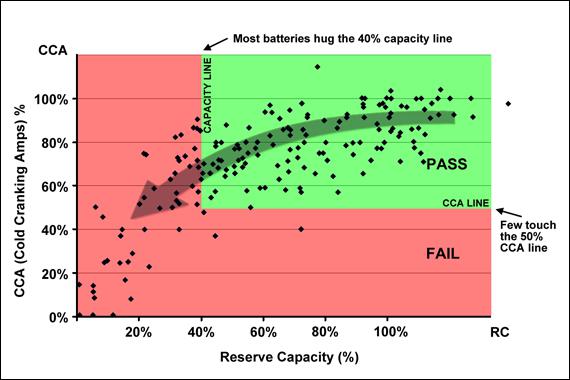
Internal resistance, temperature, age, plate condition, and battery construction affect the relationship between CCA and capacity. A battery can have adequate short-term current delivery but insufficient reserve energy, or it can have usable capacity but excessive resistance that prevents reliable cranking.
Source: Battery University

How Heat Damage and Capacity Loss Appear in Testing
Heat-related degradation commonly raises internal resistance. The starter then turns slowly or unevenly, especially under demanding conditions. A resistance-, conductance-, or impedance-based instrument may estimate reduced cranking condition, although these methods are indirect and can be influenced by temperature, SoC, battery design, and surface charge.
Capacity fade behaves differently. The battery may still produce an apparently acceptable CCA result, yet store too little energy for repeated starts, accessory operation, or periods when the alternator is not supplying power. The vehicle may appear to fail suddenly because the gradual loss of reserve capacity is not obvious in normal driving.
A useful diagnostic model treats cranking capability and capacity as separate axes:
- A healthy battery has adequate CCA and adequate capacity.
- An aging battery may have adequate CCA but inadequate capacity.
- A heat-damaged battery may have inadequate CCA because resistance and corrosion limit current delivery.
This model explains why a single CCA result is insufficient for a complete health assessment. Symptoms such as slow cranking, dim lights, repeated jump-starts, or dashboard power without engine starting are useful clues, but none proves a particular failure mode. Starter cables, grounds, the alternator, parasitic loads, and the starter motor must also be considered.
Charging can correct a low-SoC condition and may improve a test result that was depressed by undercharge. It does not generally restore a battery with severe heat damage, advanced corrosion, or substantial irreversible capacity loss. A replacement threshold such as a particular percentage of rated CCA or capacity should be treated as service guidance, not a universal rule for every flooded, AGM, EFB, or other automotive battery.
Why Capacity Is a Leading Battery-Health Indicator
A comprehensive assessment should consider both CCA and capacity. CCA testing is useful because starting current is a primary function of a vehicle battery, but capacity estimation is more complex and may reveal aging earlier than a cranking test.
The reference describes a fleet study involving 175 starter batteries, with CCA and capacity tracked during aging. It reports that normally aging batteries could lose capacity before their CCA fell below a commonly used pass threshold. A smaller comparison of aging batteries is also presented as illustrative evidence of declining capacity alongside relatively retained CCA. These findings should not be generalized to every battery: the results depend on the battery types, vehicle population, temperatures, SoC, test procedures, exclusions, and definition of failure. In particular, the reported study is not a substitute for current manufacturer or fleet-service data.
The practical implication is straightforward: a battery can look acceptable on a starting-current test while having too little reserve for reliable service. Capacity information is especially useful when a vehicle experiences repeated low-charge operation, frequent short trips, or unexplained no-start events.
Several approaches are used for different purposes:
- DIN, IEC, and BCI procedures define standardized or industry-recognized ways to rate or test battery performance. The exact procedure and rating value must be identified before comparing results.
- Conductance, impedance, and AC-response instruments estimate internal electrical properties and infer battery condition from models or correlations. They are rapid, but their outputs are estimates rather than direct full-capacity measurements.
- Load-bank testing applies a controlled electrical load and observes voltage behavior. It can provide useful evidence of cranking performance and voltage stability, but its suitability depends on the battery, SoC, temperature, equipment, and service procedure.
- Capacity testing through controlled discharge is more direct but takes longer and removes energy from the battery, making it less convenient for routine vehicle service.
A capacity value such as 40% of the original rating, or a CCA value such as 50% of the label rating, should not be used as an automatic replacement rule in every application. Follow the battery manufacturer’s test instructions, the vehicle maker’s diagnostic procedure, and the test instrument’s limits.
Spectro CA-12 Rapid Testing for 12-Volt Starter Batteries
The Spectro CA-12 is described in the supplied material as a rapid, non-invasive tester for 12-volt starter batteries. Its intended outputs include estimates of CCA, capacity, and state of charge. Because product documentation, availability, supported battery types, and software can change, current manufacturer information should be checked before relying on any specific operating range or service claim.
The operator generally needs to identify the battery construction, such as flooded or AGM, and enter the rated specification from the battery label. Correct battery selection matters because different constructions have different electrical behavior and charging requirements. A wrong rating or battery type can produce a misleading result.
The service advantage of this class of instrument is speed. A rapid test can be performed during vehicle intake or preventive maintenance without removing the battery’s stored energy through a long discharge. It can therefore help identify batteries that merit charging, further investigation, or replacement. It does not eliminate the need to inspect terminals, verify charging voltage and current, check parasitic loads, or confirm the result with the vehicle manufacturer’s procedure.
The CA-12 should be treated as a diagnostic aid rather than an authority independent of its operating conditions. Temperature, SoC, battery age, construction, connection quality, and prior charging can affect the result. Calibration, firmware, current documentation, and access restrictions should also be confirmed. The source material describes an OEM-availability caveat, but that status may no longer be current and should be verified before publication or procurement.
How Impedance-Based Rapid Battery Testing Works
Multi-frequency electrochemical impedance spectroscopy, or EIS, applies a small electrical stimulus over more than one frequency and measures the battery’s response. The resulting electrical behavior reflects processes such as ohmic resistance, charge-transfer effects, and electrochemical polarization. An instrument can compare the measured pattern with models or reference data to estimate condition, SoC, cranking capability, and in some systems capacity.
A Nyquist plot is one way to display impedance response: one component of impedance is plotted against another as the test frequency changes. The shape can help analysts distinguish different response characteristics. Not every commercial tester exposes a Nyquist plot to the operator, and a plotted curve does not by itself prove a particular failure mechanism.
The attraction of this approach is that it can estimate useful battery properties without fully discharging the battery. That is valuable in automotive service, where the battery must often remain available for starting and where a long capacity test is impractical. The estimate remains dependent on the quality of the model and on factors such as temperature, SoC, construction, age, and previous use.
Lead-acid starter batteries and lithium-ion batteries require different models, limits, and safety controls. A method developed for one chemistry should not automatically be applied to another. Lithium-ion systems also include battery-management electronics and may require isolation, communication, and protection procedures that are not relevant to a conventional 12-volt lead-acid test.
Medical imaging is sometimes used as an analogy for EIS because both approaches interpret measured responses through models rather than relying on a single visible defect. The analogy is only illustrative; it does not establish diagnostic accuracy. The broader development in battery testing is the combination of electrical measurements, chemistry-aware models, and pattern interpretation. Used with correct preparation and independent checks, these tools can provide a more complete view of battery health than a CCA-only test.
References
- Battery University | BU-905a: Testing Starter Batteries in Vehicles. (n.d.). http://www.batteryuniversity.com/article/bu-905a-testing-starter-batteries-in-vehicles
- How Parasitic Battery Drain Happens and What to Do About It. (n.d.). https://www.uti.edu/blog/automotive/parasitic-battery-drain
- How To Test Parasitic Draw on a Car Battery. (n.d.). https://www.youtube.com/watch?v=-uW5e-sLK0o
- What Is a Sulfated Battery and How to Prevent It | Power Sonic. (n.d.). https://www.power-sonic.com/what-is-a-sulfated-battery-and-how-do-you-prevent-it
- What’s a Sulfated Battery? And Is Sulfation Dangerous?. (n.d.). https://powertronbatteryco.com/blog/sulfation-and-your-battery
- What Happens to 12V Lead Acid Batteries that are Not Properly Maintained | Midtronics. (n.d.). https://www.midtronics.com/blog/what-happens-to-12v-lead-acid-batteries-that-are-not-properly-maintained
- How to Test a Car Battery: Voltage, Components & Diagnosis. (n.d.). https://www.blikai.com/blog/battery/how-to-test-a-car-battery-voltage-components-diagnosis
- How to Prevent Battery Sulfation: Definitive Guide (2026). (n.d.). https://www.batterytender.com/blogs/battery-tender-blog/how-to-prevent-battery-sulfation-definitive-guide-2026
- 6 Things That Can Drain Your Car Battery. (n.d.). https://www.batteriesplus.com/blog/power/car-battery-drain
- Are Parasitic Loads Draining Your Vehicle Batteries?. (n.d.). https://www.waytekwire.com/aboutus/the-waytek-blog/battery-management/are-parasitic-loads-draining-your-vehicle-batteries