Battery cells are built in several physical formats, and the choice of format affects far more than packaging. Cell shape influences manufacturing cost, current capability, thermal behavior, mechanical protection, safety devices, pack assembly, serviceability, and how efficiently a product can use the available volume.
The main formats used in portable electronics, tools, vehicles, and energy-storage systems are cylindrical, button or coin, prismatic, and pouch cells. These are not interchangeable categories in every application. A hearing-aid zinc-air button cell and a large lithium iron phosphate prismatic EV cell solve very different engineering problems. Even among lithium-ion cells, the same chemistry can behave differently when packaged as a wound cylinder, a rigid rectangular can, or a flexible laminate pouch.
The best cell format is therefore application-dependent. A pack designer must balance energy, power, cooling, mechanical support, safety integration, manufacturing scale, and cost rather than selecting a format by capacity alone.
Cylindrical Cells
Cylindrical cells are among the most widely used rechargeable battery formats because they combine mature manufacturing, good mechanical stability, and strong dimensional standardization. Common lithium-ion cylindrical cells use a wound internal structure often called a jelly roll: coated positive and negative electrode foils are separated by a porous separator, wound into a spiral, inserted into a metal can, filled with electrolyte, and sealed.
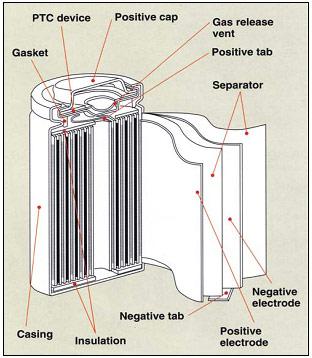
Source: Battery University

The metal can is a major part of the format’s appeal. It provides structural strength, helps contain internal pressure within design limits, and gives the cell predictable mechanical dimensions. Cylindrical geometry also tolerates internal pressure better than flat laminate constructions, although this does not remove the need for electrical and thermal protection at cell and pack level.
Typical safety features in cylindrical lithium-ion cells may include:
- Positive thermal coefficient devices, which increase resistance under abnormal heating or excessive current.
- Pressure relief vents, which provide a controlled venting path if internal pressure rises beyond the cell’s design limit.
- Charge interrupt devices, used in some cylindrical cells to disconnect the internal current path when pressure or abuse conditions reach a defined threshold.
These features are not a substitute for a battery management system, correct charging, fusing, thermal design, and validated pack construction. They are cell-level safety mechanisms that help manage specific failure modes.
Cylindrical cells are used in laptops, power tools, medical devices, e-bikes, portable instruments, energy-storage products, and many electric-vehicle battery packs. Their standardized dimensions make them easy to automate and easy to combine in series and parallel groups. The drawback is that cylinders do not fill rectangular pack volumes perfectly. Spaces between cells require support structures, busbars, cooling paths, potting, holders, or other pack hardware. As a result, good cell-level energy density does not automatically translate into the best pack-level volumetric efficiency.
The best-known cylindrical lithium-ion format is the 18650, named for its approximate dimensions: 18 mm diameter and 65 mm length. It became important because it offered a useful balance of energy, cost, manufacturability, and availability. Modern 18650 cells commonly fall around 2,500–3,500 mAh, depending on chemistry, power rating, manufacturer, and cycle-life target. High-power 18650 cells may trade capacity for lower resistance and higher current capability.
The 21700 format is larger, at about 21 mm diameter and 70 mm length. Its larger can provides roughly 46–50% more volume than an 18650 cell, allowing more active material per cell. Modern high-capacity 21700 cells commonly reach roughly 4,000–5,600 mAh, again depending on chemistry and model. Because each cell can store more energy, a pack can often use fewer cells for the same nominal capacity. That can reduce parallel connections, interconnect count, monitoring points, and assembly complexity.
21700 adoption has grown in EVs, e-bikes, power tools, and high-drain industrial applications. The 18650 format remains important in legacy products, replacement packs, flashlights, laptops, power banks, and cost-sensitive designs where tooling, supply chains, and mechanical envelopes are already built around it.
Compared with prismatic and pouch cells, cylindrical cells generally offer high manufacturing maturity and robust mechanical containment. They can also be thermally predictable when packs are designed with airflow, liquid cooling, or conductive heat paths around the cells. Their main packaging limitation is geometric: round cells leave pack-level voids unless the pack is carefully engineered around the cell array.
Button and Coin Cells
Button and coin cells are compact, low-profile cells used where the product is too small for larger cylindrical, prismatic, or pouch cells. The terms are often used together, although in common usage “coin cell” usually suggests a wider, flatter cell, while “button cell” can include very small cells used in hearing aids and miniature electronics.
Their flat circular form makes them suitable for watches, hearing aids, medical sensors, key fobs, calculators, remote controls, memory-backup circuits, small instruments, and compact wireless devices. Many common coin cells are primary cells, such as lithium or alkaline types, intended for one-time discharge. They should not be recharged unless the cell is explicitly designed and specified as rechargeable.
Button and coin cells have limited capacity and limited current capability. They are well suited to low-power standby loads, intermittent signaling, real-time clock backup, small displays, and miniature sensors. They are not appropriate for high-drain motors, heaters, high-power transmitters, or traction loads.
Where a higher voltage is needed in a small space, button cells can be stacked or connected in series. This increases voltage but does not increase the capacity of the individual cell string. The practical current capability remains constrained by the small electrode area, cell chemistry, internal resistance, and thermal limits.
Safety deserves special attention. Button and coin cells can be hazardous if swallowed by children or pets, and lithium coin cells are a particular concern because their voltage and shape can create dangerous internal injury mechanisms after ingestion. Products using these cells should have secure battery compartments, preferably requiring a tool or deliberate multi-step action to open. Current safety improvements include child-resistant packaging, bitter coatings on some cells, and stronger device-compartment retention practices.
Other risks include short-circuiting loose cells in pockets, drawers, or waste containers; leakage from aged or abused cells; and incorrect charging attempts. Small cells should be stored in original packaging or insulated compartments, kept away from metal objects, and replaced with the correct chemistry and size specified by the device manufacturer.
Prismatic Cells
Prismatic cells use a rectangular rigid enclosure rather than a round metal can or flexible laminate pouch. The rectangular shape improves space utilization in many products because cells can be stacked or arranged with less unused volume than a cylindrical array. In lithium-ion batteries, prismatic cells may use stacked electrode sheets or a flattened wound construction inside a metal case.
The thin, flat profile of prismatic cells made them attractive in mobile phones, tablets, laptops, and other compact electronics. In larger formats, prismatic cells are also prominent in electric vehicles and stationary energy-storage systems, especially where module simplicity, clean stacking, and efficient rectangular packaging are priorities.
One advantage of large-format prismatic cells is that a pack may need far fewer cells than a pack based on small cylindrical cells. Fewer cells can reduce interconnect count, simplify mechanical stacking, and reduce some assembly steps. This can be valuable in EV and stationary packs, where service architecture, cell monitoring strategy, module count, and manufacturing automation all affect cost and reliability.
Prismatic cells also have design challenges. Large flat cells must manage swelling, mechanical compression, and heat dissipation across broad surfaces. Depending on chemistry, size, and internal construction, heat may not leave the center of a large cell as easily as it leaves a small cell with more surface area per unit energy. Pack designers must account for cooling plate placement, thermal interface materials, clamping loads, expansion allowance, and the effect of compression on cycle life.
Cycle life is not determined by format alone. It depends heavily on cell chemistry, electrode design, depth of discharge, charge voltage limits, temperature, C-rate, compression, and battery-management strategy. A well-designed prismatic LFP pack can be highly durable, while a poorly cooled high-energy prismatic pack can age rapidly. The format creates design constraints; it does not guarantee performance.
Prismatic cells are especially common among major Asian EV battery manufacturers and are widely used in lithium iron phosphate vehicle packs. Their rectangular form works well with cell-to-module and cell-to-pack architectures, where large cells are stacked into a mechanically efficient pack structure. The trade-off is that each large cell represents a larger unit of energy, so quality control, swelling management, and fault containment must be engineered carefully.
Pouch Cells
Pouch cells use a sealed laminate foil package instead of a rigid cylindrical can or rectangular metal case. The internal electrodes are stacked or folded, connected to tabs, filled with electrolyte, and sealed inside a flexible pouch. Removing the heavy rigid can can improve cell-level gravimetric energy density because less mass is spent on casing.
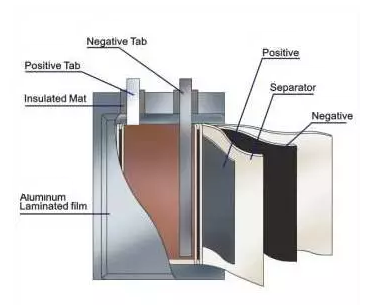
Source: Battery University
The pouch format is also highly flexible in dimensions. Manufacturers can produce thin, wide, or custom-shaped cells that make efficient use of available product volume. This is why pouch cells are common in smartphones, tablets, wearables, drones, power banks, high-performance portable electronics, and some EV packs.
At cell level, pouch cells can provide strong energy density and excellent packaging efficiency. At pack level, the result depends on how much additional structure is required. Pouch cells typically need mechanical support, protection against puncture and bending, controlled compression, swelling allowance, and appropriate thermal paths. A light cell does not necessarily mean a light finished pack if substantial frames, cooling plates, pressure pads, and protective housings are needed.
Swelling is an important design consideration. Some dimensional change over life can be normal, especially as cells age and generate small amounts of gas. The pack must allow for this behavior without over-stressing the pouch seal or adjacent components. However, excessive swelling is a warning sign. It can indicate gas generation from abuse, aging, overcharge, overheating, internal damage, or other failure mechanisms. Swollen pouch cells should not be punctured, compressed casually, or forced back into a device.
The flexible laminate package is less mechanically robust than a metal can. Pouch cells are vulnerable to puncture, edge damage, bending stress, and moisture ingress if the seal is compromised. The seal quality is therefore critical. Moisture entering the cell can trigger unwanted chemical reactions and degrade safety and performance.
Manufacturing and integration costs vary by scale and application. Pouch cells may save casing weight and allow efficient use of space, but pack-level integration can require more support, compression, and protection than cylindrical or rigid prismatic formats. In consumer electronics, the thin shape is often worth the integration effort. In EV packs, pouch cells remain important for some manufacturers, while prismatic and cylindrical formats compete strongly depending on OEM strategy, cooling architecture, and production scale.
Cell Format Comparison and Market Trends
Each battery cell format represents a different compromise between manufacturability, packaging efficiency, safety integration, and mechanical design.
| Format | Main strengths | Main limitations | Typical use cases |
|---|---|---|---|
| Cylindrical | Mature automated manufacturing, strong metal can, standardized sizes, good pressure tolerance | Pack-level voids, many cells and interconnects in large packs, support structures required | Laptops, tools, e-bikes, medical devices, EV packs, energy storage |
| Button / coin | Extremely compact, low profile, simple for low-power devices | Small capacity, low current capability, ingestion hazard, many types are non-rechargeable | Watches, hearing aids, key fobs, sensors, memory backup |
| Prismatic | Efficient rectangular packaging, fewer large cells per pack, simple stacking | Swelling and compression control, thermal gradients in large cells, demanding mechanical design | Mobile electronics, EVs, stationary storage, LFP vehicle packs |
| Pouch | Light cell package, flexible dimensions, high cell-level packaging efficiency | Needs external support, vulnerable to puncture and seal damage, swelling management required | Phones, tablets, wearables, drones, power banks, some EV packs |
Cylindrical cells remain attractive where manufacturing maturity, mechanical robustness, and modular pack scaling are important. The 21700 format continues to grow in many high-energy and high-power applications because it offers more energy per cell than 18650 while retaining the benefits of cylindrical production. The 18650 format remains widely used because of its installed base, mature tooling, and broad availability.
Prismatic cells are prominent in EV and stationary storage, particularly where large-format cells can reduce the number of electrical joints and simplify the pack layout. They are especially visible in LFP-based vehicle packs and in manufacturing ecosystems that emphasize rectangular cell stacking.
Pouch cells remain valuable where thin, lightweight, custom-shaped cells are needed. Consumer electronics continue to benefit from the format, and some automotive manufacturers use pouch cells where the pack architecture is designed around compression frames and thermal plates.
Cost trends should be interpreted cautiously. Cylindrical manufacturing has long benefited from automation and enormous production scale. Historically, prismatic and pouch cells were often viewed as more expensive to manufacture, but their costs have narrowed as production volumes, automation, and process control improved. Current cost depends on chemistry, region, cell size, yield, equipment utilization, raw material pricing, and the pack architecture required around the cell.
Emerging larger cylindrical formats, such as 4680 cells, aim to reduce pack complexity by increasing energy per cell and lowering the number of cells needed in large packs. Their success depends on manufacturing ramp, yield, thermal management, structural integration, and OEM strategy. They do not eliminate the role of 18650, 21700, prismatic, or pouch cells.
No single cell format is best for all products. A small medical sensor may need a coin cell, a power tool may favor cylindrical high-rate cells, an LFP vehicle pack may use large prismatic cells, and a thin tablet may require a pouch cell. The correct selection follows the product requirements: available shape, energy target, discharge rate, cooling method, safety strategy, manufacturing scale, service expectations, and total system cost.
References
- BU-301a: Types of Battery Cells. (n.d.). http://www.batteryuniversity.com/article/bu-301a-types-of-battery-cells
- 18650 and 21700 Battery Market Research Report 2034. (n.d.). https://dataintelo.com/report/global-18650-and-21700-battery-market
- Evolution and Comparison of 18650 and 21700 Lithium Battery Cells. (n.d.). https://www.wonderfulpcb.com/blog/18650-vs-21700-lithium-battery-cells-evolution-comparison
- Lithium Battery Cell Models and the Industry Shifts 21700 vs. 18650. (n.d.). https://www.epectec.com/articles/lithium-battery-cell-models-and-the-industry-shifts-21700-vs-18650.html
- Comparing Battery Cell Types: Prismatic, Pouch, and Cylindrical Cells Explained - Molicel. (n.d.). https://www.molicel.com/blog/comparing-battery-cell-types-prismatic-pouch-and-cylindrical-cells-explained
- 18650 vs. 21700 Batteries: What’s the Difference? | Ultimate Guide. (n.d.). https://www.18650batterystore.com/pages/18650-vs-21700-battery-differences-ebikes-drones
- 18650 vs. 21700 Li-ion cells – A direct comparison of electrochemical, thermal, and geometrical properties. (n.d.). https://www.sciencedirect.com/science/article/pii/S0378775320309186
- Energy Density of Cylindrical Li-Ion Cells: A Comparison of Commercial 18650 to the 21700 Cells - IOPscience. (n.d.). https://iopscience.iop.org/article/10.1149/2.0281814jes
- The Ultimate Guide to 21700 Batteries: Specs, Comparison & Top Brands. (n.d.). https://www.evlithium.com/Blog/guide-21700-battery-specifications.html
- The Market Size, Types, and Trends of Cylindrical Lithium .... (n.d.). https://www.leadintelligent.com/en/cylindrical-batteries-market-size-types-and-trends