A battery that performs well when new does not remain a 100% battery forever. Capacity fades with use, age, operating temperature, discharge rate, and storage history. For equipment that must finish a shift, complete a mission, crank an engine, or remain available for an emergency, the important question is not only whether the battery is charged today. It is whether the battery still has enough usable capacity after real operating demand.
Spare capacity is the operating margin between the energy a task normally requires and the energy the battery can actually deliver under the relevant conditions. Designers often build this margin into the original pack size because a battery with no reserve when new will become unreliable as soon as normal aging begins. Battery University compares this reserve to carrying extra fuel in an aircraft so that a waiting pattern or a second landing approach remains possible when conditions change.
Many demanding applications consider replacement when a pack has faded to about 80% of its original capacity, but that value is not a universal retirement rule. Some systems need a higher margin because failure is costly or unsafe. Others can tolerate lower measured capacity if the duty cycle is short, the load is light, or batteries are frequently exchanged. The correct decision comes from measuring actual remaining capacity and matching it to the application rather than relying only on age, voltage, or user complaints.
Why Batteries Need Spare Capacity
A new battery should deliver close to its rated capacity when it is tested under the conditions used for that rating. In practice, the rating is only a starting point. The available capacity seen by the equipment can be lower because of aging, temperature, high load, state-of-charge error, cell imbalance, or a battery management system cutoff. Over time, chemical and mechanical changes inside the cell reduce the amount of charge that can be stored and returned to the load.
This is why practical battery systems are rarely sized with zero margin. If a scanner, radio, medical device, vehicle system, or portable instrument needs a certain amount of energy to complete its normal task, the pack should be sized so that the task can still be completed after reasonable capacity fade. The reserve also protects against operating days that are heavier than expected.
Spare capacity serves several purposes:
- Aging allowance: the pack can lose capacity over its service life and still meet the workload.
- Temperature allowance: cold operation may reduce usable capacity, especially for lithium-ion cells.
- Load allowance: high current pulses can expose voltage sag and usable-capacity limits.
- Operational allowance: delays, emergency use, or longer-than-normal shifts may require energy beyond the planned duty cycle.
- Measurement allowance: state-of-charge indicators and fuel gauges are not perfect, especially as batteries age.
The aircraft fuel analogy is useful because the battery is not sized only for the average trip. It must also cover reasonable worst-case conditions. A battery with just enough capacity for a normal cycle may appear efficient on paper, but it gives the operator no room for cold weather, a longer route, unexpected waiting time, or a second attempt at a task.
The often-cited 80% replacement point reflects this reserve concept. If a pack was originally oversized so that 80% of original capacity still completes the job with enough margin, replacing it at around that point can preserve reliability. However, 80% is not a law of electrochemistry. It is a practical service threshold used in many demanding applications. A more critical system may require retirement earlier, while a low-consequence or short-duration application may continue to use batteries below 80% if testing confirms adequate reserve.
A good maintenance program therefore separates two questions:
- What is the battery’s measured capacity now?
- Is that capacity sufficient for this specific application with an acceptable reserve?
The first question is answered by testing. The second is answered by the load profile, operating environment, replacement policy, and consequence of failure.
How Cold Temperature and Cell Design Reduce Available Capacity
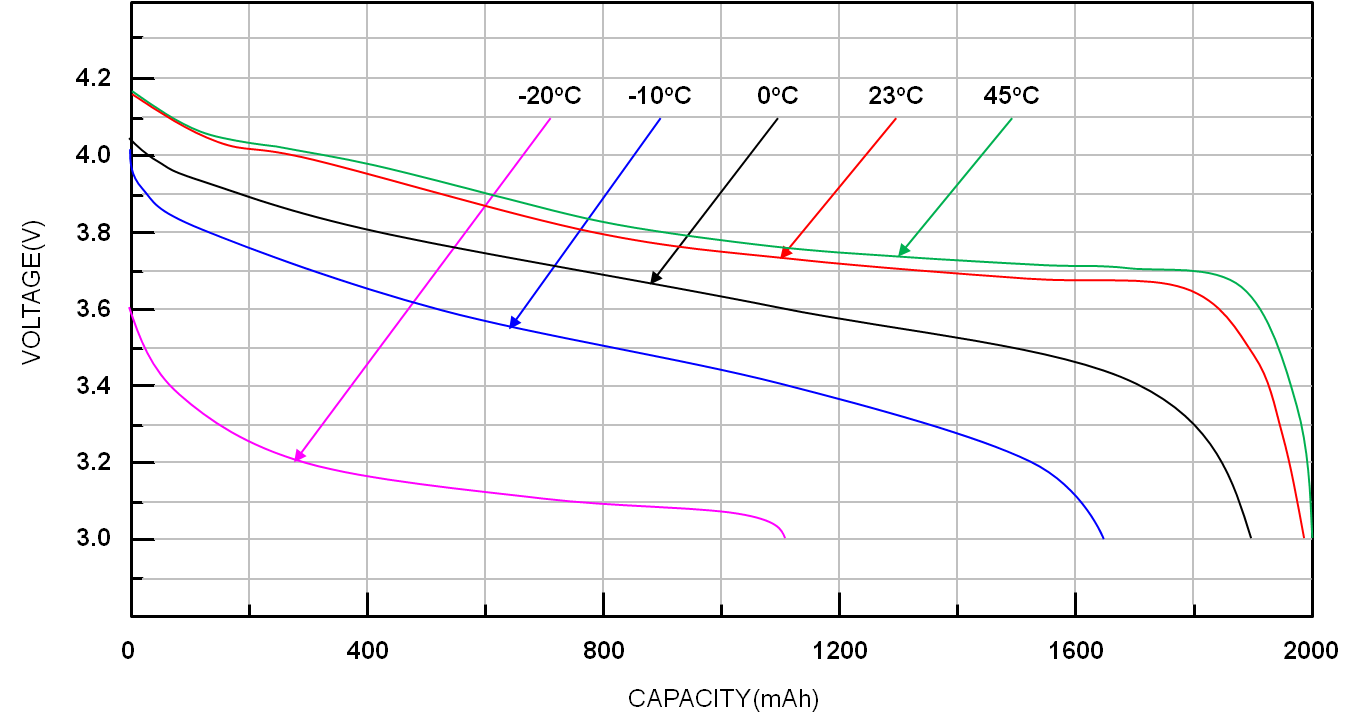
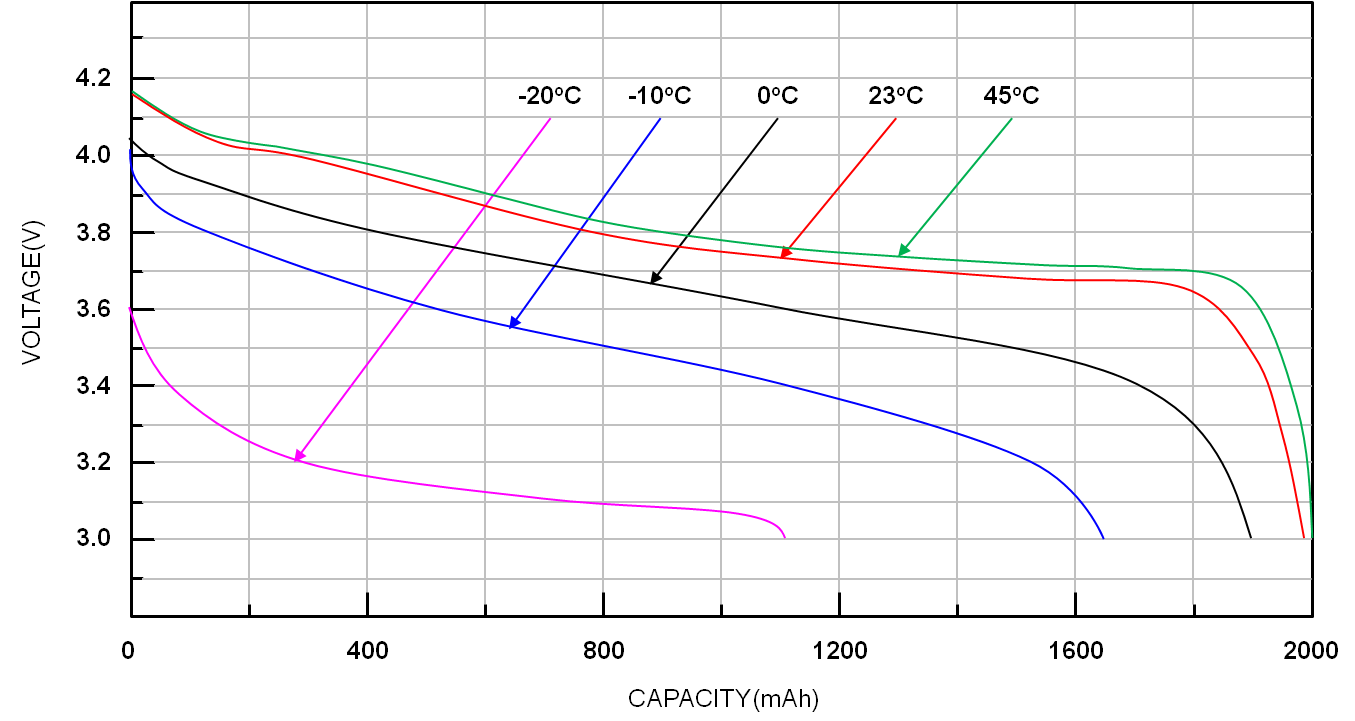
Low temperature reduces available battery capacity because electrochemical reactions slow down and internal resistance rises. The battery may still contain charge, but it cannot deliver that charge as effectively at the required voltage and current. This effect is especially important for lithium-ion packs used outdoors, in vehicles, in cold storage facilities, or in equipment that must operate immediately after being exposed to winter conditions.
Battery University gives an example in which a lithium-ion Energy Cell shows about 17% capacity loss at 0°C. The exact loss in a real pack depends on chemistry, cell construction, current draw, cutoff voltage, state of charge, pack design, and how long the battery has been cold-soaked. The important engineering point is that a capacity test or runtime estimate made at room temperature may overstate what the equipment can do in cold service.
Cold performance also depends on whether the lithium-ion cell is optimized as an Energy Cell or a Power Cell. These terms are not single universal standards, but they describe a common design tradeoff:
| Cell design emphasis | Typical priority | Cold/high-load behavior |
|---|---|---|
| Energy Cell | Maximum runtime or energy density | More vulnerable to voltage sag under high load and cold conditions |
| Power Cell | High current delivery and lower impedance | Generally better suited to high loads and cold operation, often with less total energy density |
An Energy Cell is selected when the goal is to store as much energy as possible in a given size or weight. That can be the right choice for long runtime at moderate current. A Power Cell is selected when the application needs strong current delivery, rapid response, or better voltage support under stress. In cold operation, the lower-impedance behavior of a Power Cell can help maintain usable voltage where an energy-optimized cell may reach the equipment cutoff sooner.
This distinction matters when verifying spare capacity. A room-temperature capacity number may not fully describe field reliability. A pack can test acceptably under a gentle discharge but fail early when the actual device demands high current in a cold environment. For that reason, the test method should be related to the application whenever possible. At minimum, maintenance staff should interpret a capacity result with awareness of temperature and load.
Practical implications include:
- A pack that is marginal at room temperature may be unacceptable in cold service.
- A high-energy cell may deliver long runtime at moderate load but still be a poor fit for high-current pulses.
- A power-optimized cell may provide better reliability under demanding conditions even if its rated energy is lower.
- Fleet thresholds may need to be higher for winter operation, emergency service, or equipment used after cold storage.
Temperature is therefore not a minor correction. It is part of the capacity requirement. If the job must be completed at 0°C, the required spare capacity should be evaluated for that condition, not only for a bench test at normal indoor temperature.
Checking Spare Capacity with a Battery Analyzer
Spare capacity is best checked by testing batteries that are close to retirement after they have completed a busy day, shift, route, or mission. Testing a freshly charged battery tells you its full available capacity under the test conditions. Testing it after real use reveals something more operationally important: how much reserve remained when the user was finished.
A battery analyzer is useful because it can measure capacity through a controlled discharge and charge process rather than inferring health only from open-circuit voltage. Voltage can indicate whether a battery is charged or deeply discharged, but it is a limited indicator of usable capacity. A worn battery can show a plausible voltage after charge and still deliver poor runtime. Conversely, a battery may have low state of charge but still be healthy after recharging.
A controlled capacity test removes much of that ambiguity. The analyzer discharges the battery under defined conditions until the appropriate cutoff point, measures the delivered ampere-hours or watt-hours, and then recharges the pack. The result is a direct measurement of energy delivery under the test profile.
Cadex analyzers are cited by Battery University as providing a Prime program for this type of assessment. In that program, the analyzer applies a discharge before charge. The first displayed reading reflects the spare capacity remaining in the battery at the time it was inserted into the analyzer. The second reading represents the full capacity after the battery has been charged and tested.
Source: Battery University
This two-reading concept is practical for fleet management:
- First reading: remaining spare capacity after use. This shows whether the battery returned with enough reserve or was nearly exhausted.
- Second reading: full capacity after charge. This shows the battery’s present capacity capability compared with its original rating or the fleet threshold.
For example, if many batteries come back after a normal workday with very little spare capacity, the fleet may be operating too close to failure. The batteries might be aging, the workload may have increased, cold temperature may be reducing performance, or the pass/fail threshold may be set too low. If most batteries return with a large reserve even after demanding use, the fleet may be able to tolerate a lower retirement threshold without affecting reliability.
A good analyzer-based process should be repeatable. Operators should identify the battery, record its rated capacity, note the application, document the test conditions, and compare results with the same threshold policy each time. Capacity tests are most useful when results are trended over time rather than treated as isolated events.
Technical note: a controlled discharge capacity test is more informative than an open-circuit voltage check alone. Voltage is still useful for quick screening and safety checks, but it does not reliably quantify remaining runtime in aged batteries.
Setting Pass/Fail Capacity Targets for Battery Fleets
A fleet does not need a single universal capacity threshold for every battery type and application. The correct pass/fail point depends on how much energy the equipment requires, how much reserve is needed, and what happens if the battery fails before the task is complete.
A practical approach is to start with a conservative target, often near the commonly used 80% capacity level for demanding applications, and then adjust the target using operating data. The adjustment should be based on returned spare capacity, user experience, failure reports, seasonal conditions, and the cost of replacing batteries early versus the risk of keeping weak batteries in service.
If batteries consistently return from normal use with little reserve, the capacity target should be raised. This provides more margin and reduces the chance that a longer shift, colder day, or emergency event will cause failure. Low reserve is a warning sign even when the battery technically completed the day. It means the system is relying on luck rather than margin.
If batteries consistently return with ample reserve after a full day or mission, the target may be lowered. This allows more of the battery’s service life to be used before replacement. Lowering the threshold can reduce cost and waste, but it should be done only when measured data shows that reliability is not being compromised.
The reference examples illustrate why application context matters. Some warehouse scanners may operate efficiently with batteries that have about 70% capacity because the load and shift pattern still leave enough reserve. A vehicle starter battery may continue to work at a reduced measured capacity, such as around 40%, if it can still provide the required cranking performance for the conditions. These examples should not be copied blindly into other systems. They show that the useful threshold is application-dependent.
Important factors when setting a target include:
- Load profile: steady low-current loads, pulsed loads, and high-current starts stress batteries differently.
- Operating temperature: cold service may require a higher capacity margin.
- Mission duration: longer routes or shifts need more reserve than short tasks.
- Charging opportunity: batteries that can be recharged during the day may tolerate less stored capacity than batteries used continuously.
- Failure consequence: emergency, medical, aviation, security, or safety-related equipment requires more conservative margins.
- Replacement cost and logistics: a large fleet may benefit from data-based thresholds that avoid replacing batteries too early.
- Battery chemistry and design: energy-optimized and power-optimized cells age and perform differently under load.
A simple fleet policy can use three categories instead of only pass and fail:
| Category | Meaning | Typical action |
|---|---|---|
| Pass | Capacity and returned reserve meet the application requirement | Return to service |
| Watch | Battery still works but margin is shrinking | Retest more often or assign to lighter duty |
| Fail | Capacity or reserve is below the required threshold | Remove from service or replace |
The watch category is useful because capacity fade is gradual. It prevents a battery from moving directly from apparently acceptable to unexpectedly unreliable. It also allows operators to use older batteries in less demanding roles while reserving stronger packs for critical work.
The best threshold is the one that protects the task, not the one that looks neat on a specification sheet. A battery fleet with measured capacity data, returned-reserve data, and application-specific pass/fail targets can reduce unexpected shutdowns while avoiding unnecessary early replacement. That is the real purpose of verifying spare capacity: to keep enough energy margin in service for the work the battery must actually perform.
References
- Battery University | BU-504: How to Verify Sufficient Battery Capacity. (n.d.). http://www.batteryuniversity.com/article/bu-504-how-to-verify-sufficient-battery-capacity
- Battery University | BU-604: How to Process Data from a “Smart”…. (n.d.). http://www.batteryuniversity.com/article/bu-604-how-to-process-data-from-a-smart-battery
- How to verify lithium battery true capacity. (n.d.). https://www.facebook.com/groups/345353122489028/posts/2755581078132875
- BU-904: How to Measure Capacity. (n.d.). http://www.batteryuniversity.com/article/bu-904-how-to-measure-capacity
- Stop Guessing: Accurately Size Your LiFePO4 Battery Bank. (n.d.). https://www.anernstore.com/blogs/off-grid-solar-solutions/accurately-size-lifepo4-battery
- The Ultimate Guide to Testing LiFePO4 Batteries: Voltage, Capacity & H – WEIZE. (n.d.). https://www.weizeus.com/blogs/weize/the-ultimate-guide-to-testing-lifepo4-batteries-voltage-capacity-health-checks
- Battery Bank Sizing by Daily Energy Usage | SolarMathLab. (n.d.). https://solarmathlab.com/content/batteries/solar-battery-bank-sizing-by-daily-energy-usage.html
- How do l size a LiFePO4 Lithium battery bank for my system?. (n.d.). https://www.weizeus.com/blogs/weize/how-do-l-size-a-lifepo4-lithium-battery-bank-for-my-system
- How to Measure LiFePO4 Battery Capacity. (n.d.). https://leforsolar.com/how-do-you-measure-the-capacity-of-a-battery%EF%BC%9F
- How to Calculate the Right Size Battery? Battery Bank Size .... (n.d.). https://www.facebook.com/electricaltechnology.info/posts/how-to-calculate-the-right-size-battery-battery-bank-size-calculator/956725558305919