Battery capacity loss is the gradual reduction in the amount of usable energy a battery can deliver under specified conditions. It is not the same as simply being discharged. A discharged battery can normally be recharged; an aged battery has lost part of its practical storage capability because some active material, lithium inventory, electrolyte function, or internal structure is no longer available for normal operation.
All rechargeable batteries age, even when they are not used. Cycling, storage time, temperature, depth of discharge, charge voltage, and load current all influence how quickly capacity fades. The visible symptom is shorter runtime, but the underlying causes differ substantially between lead-acid, nickel-based, and lithium-ion batteries.
How Usable Battery Capacity Shrinks Over Time
A useful way to visualize battery capacity is to divide the stored-energy space into three conceptual portions:
- Available energy: the energy that can be delivered immediately during discharge.
- Empty but refillable capacity: the portion that has been discharged but can be restored by charging.
- Inactive or unusable capacity: the portion that can no longer participate effectively in charge and discharge. Battery University describes this inactive fraction as “rock content.”
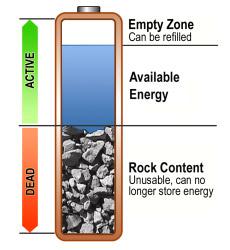
Source: Battery University

When a battery is new, it should be close to its rated capacity when tested under the specified conditions. In real systems, however, many packs quickly operate below the ideal nameplate value because of normal manufacturing variation, early aging, storage history, operating temperature, and the way the battery is loaded.
Capacity loss means the inactive fraction has grown. A pack may still reach its normal terminal voltage, and it may appear to charge normally, but it cannot deliver the same watt-hours or ampere-hours as before. This is why voltage alone is often a poor indicator of remaining battery health. A faded battery can show a plausible open-circuit voltage while failing to support the expected runtime or load current.
This distinction is important in maintenance decisions. A battery at low state of charge needs charging. A battery with significant capacity fade has lost part of its energy-storage capability, and charging cannot fully restore it unless the loss is caused by a reversible mechanism such as certain nickel-battery memory effects.
Cycle Count, Age, and Discharge Depth as Drivers of Capacity Fade
Capacity fade is usually linked to both cycle count and calendar age. Cycle aging is caused by repeated charge and discharge. Calendar aging occurs while the cell exists, even at rest, because internal chemical reactions continue slowly over time.
In many applications, capacity loss appears approximately gradual over much of the battery life. The rate is not fixed, however. It can accelerate when the battery is exposed to high stress conditions such as excessive temperature, high current, deep cycling, overcharge, prolonged undercharge, or operation near the edge of its safe voltage range.
Depth of discharge is one of the most practical operating factors. A deep discharge generally stresses rechargeable batteries more than a shallow discharge. For many chemistries, it is better to recharge more often than to routinely run the battery fully down. This does not mean every battery must be kept near full charge at all times; rather, unnecessary full-depth cycling should be avoided unless the chemistry or battery-management procedure specifically calls for it.
For lithium-ion batteries, capacity fade is influenced by several interacting stress factors:
- Temperature: elevated temperature accelerates many side reactions, while very low temperature can increase stress during charging and reduce apparent usable capacity during discharge.
- C-rate: high charge or discharge current increases polarization, heat generation, and mechanical and electrochemical stress.
- State of charge: extended storage or operation at high state of charge can accelerate lithium-ion aging.
- Cycling range: both the depth of discharge and the voltage range used during cycling affect degradation rate.
These factors matter because a cycle is not always equivalent in severity. A battery cycled gently over a moderate state-of-charge window may age very differently from the same model repeatedly cycled from full charge to deep discharge under high load and high temperature.
Full Discharge, Calibration, and Replacement Thresholds
A full discharge is not a universal battery-maintenance tool. It is useful in specific cases, but harmful or unnecessary in others.
Periodic full discharge is generally associated with two purposes:
- Nickel-based battery maintenance: nickel-cadmium and some nickel-metal hydride batteries can develop memory-related or crystalline effects. Controlled full discharge or conditioning can help reduce some recoverable performance loss.
- Smart-battery calibration: packs with fuel-gauge electronics may need an occasional full discharge-charge cycle so the gauge can relearn the usable capacity. This calibrates the state-of-charge reporting system; it does not make a worn cell chemically new.
Routine full discharge should not be treated as beneficial for lithium-ion batteries. Lithium-ion packs are normally better served by avoiding unnecessary deep discharge and by operating within the limits set by the battery-management system and manufacturer.
A common practical replacement point for many rechargeable battery packs is when measured capacity falls to about 80 percent of rated capacity. This threshold is widely used because it leaves less reserve for unexpected load, cold conditions, aging imbalance, and end-of-shift runtime requirements. It is not a universal safety boundary. Some low-demand applications can tolerate lower capacity, while critical systems may require replacement earlier.
Battery University notes that lithium- and nickel-based batteries commonly deliver roughly 300 to 500 full discharge-charge cycles before capacity may fall below about 80 percent, depending on cell design and operating conditions. Actual service life can be shorter or longer. A lightly loaded pack kept within a moderate temperature and state-of-charge range may last longer than a pack exposed to heat, deep cycling, and high current.
Replacement decisions should consider more than ampere-hour capacity alone. Important practical factors include:
- required runtime reserve;
- peak load current;
- cold-temperature performance;
- internal resistance and voltage sag;
- cell balance in series packs;
- safety margin required by the application.
A battery used in emergency equipment, medical devices, aviation support, or industrial backup service may need conservative replacement criteria. A pack used in a noncritical device may remain useful after it has fallen below the conventional 80 percent level, provided it still meets the application’s load and runtime requirements.
How Capacity Loss Changes Charging Behavior
As the inactive portion of a battery grows, there may be less active material left to refill. In some faded batteries this makes the charge process appear shorter. The battery reaches the charger’s termination condition sooner, but the result is not improved performance; it simply stores less usable energy.
This shortened charge time is especially noticeable in some nickel-based batteries and can also be seen in lead-acid batteries. A battery that charges unusually quickly and then discharges unusually quickly is often not “efficient”; it may simply have reduced capacity.
Lithium-ion batteries do not always follow this pattern. Aged lithium-ion cells often develop higher internal resistance and reduced charge-transfer capability. These changes can increase voltage rise during charging, generate more heat, and limit how readily lithium ions move through the cell. In such cases, charging may not become faster. It can become slower, more restricted, or more likely to terminate early depending on the charger algorithm and battery-management system.
This is why charge time should be interpreted carefully. A short charge time can indicate reduced capacity, but a long charge time can indicate increased impedance, cell imbalance, low-temperature limitations, or conservative charge control. Capacity testing under controlled load remains a more reliable method for evaluating battery health.
Chemistry-Specific Causes of Capacity Loss
All rechargeable batteries lose capacity, but the dominant aging mechanisms depend on chemistry, construction, and operating history. The same symptom—shorter runtime—can come from very different physical and electrochemical causes.
| Battery type | Common capacity-loss mechanisms | Recoverability |
|---|---|---|
| Lead-acid | Sulfation, grid corrosion, shedding and structural degradation | Some sulfation may be reduced if addressed early; much aging is permanent |
| Nickel-based | Crystalline formation, memory-related effects, electrolyte and electrode aging | Some loss can be improved by controlled discharge or conditioning |
| Lithium-ion | SEI growth, loss of cyclable lithium, electrolyte decomposition, lithium plating, electrode degradation, rising impedance | Most true capacity fade is permanent |
The following sections separate the main aging patterns by chemistry.
Lead-Acid Batteries: Sulfation and Grid Corrosion
In lead-acid batteries, sulfation is a major cause of capacity loss. During normal discharge, lead sulfate forms on the plates. Under proper recharge conditions, much of this material is converted back into active material. Problems arise when a battery remains undercharged, is stored at low state of charge, or is repeatedly operated without full recovery. Lead sulfate can become more stable and harder to reconvert, reducing the active plate area and limiting capacity.
Sulfation is especially relevant in standby systems, seasonal equipment, vehicles with parasitic loads, and batteries that are chronically undercharged. The result is lower available capacity, weaker load support, and increased voltage sag.
Lead-acid batteries also age through grid corrosion and structural degradation. The grid supports the active material and conducts current. Over time, corrosion, shedding of active material, and other internal changes reduce the battery’s ability to store and deliver energy. These mechanisms are generally age-related and are not fully reversible by charging.
Good charging practice can slow lead-acid capacity loss, but it cannot stop aging. Avoiding prolonged low state of charge, preventing chronic undercharge, and controlling temperature are important because they reduce the conditions that accelerate sulfation and corrosion.
Nickel-Based Batteries: Crystalline Formation and Recoverable Loss
Nickel-based batteries, including nickel-cadmium and nickel-metal hydride types, can lose apparent capacity through crystalline formation and memory-related behavior. If a nickel-based cell is repeatedly cycled over a narrow range or is not periodically exercised appropriately, the voltage profile and available capacity can become distorted.
Some of this loss is recoverable. Controlled full discharge and conditioning cycles can help break down certain crystalline formations and restore part of the usable capacity. This is the basis for the older recommendation to periodically discharge nickel-based batteries. The procedure must be appropriate for the cell type and pack design; uncontrolled over-discharge can damage cells, especially in multi-cell packs where weaker cells may reverse polarity.
It is important to distinguish recoverable memory-related effects from permanent aging. Nickel-based cells also suffer from irreversible wear: electrolyte changes, separator degradation, internal shorts, loss of active material, and general electrode aging. Conditioning can improve some performance symptoms, but it cannot restore a battery whose materials have reached end of life.
Lithium-Ion Batteries: Oxidation, Side Reactions, and Rising Impedance
Lithium-ion capacity fade is primarily driven by internal chemical and structural changes. Battery University describes lithium-ion aging in terms of natural cell oxidation. In modern technical terms, this includes several related degradation mechanisms that consume usable lithium, reduce active electrode area, impede ion transport, or increase internal resistance.
One central mechanism is growth of the solid electrolyte interphase, or SEI, on the negative electrode. A stable SEI is necessary for lithium-ion operation because it helps protect the anode from continuous electrolyte decomposition. However, continued SEI growth consumes cyclable lithium and electrolyte. The result is loss of capacity and rising impedance.
Other lithium-ion degradation mechanisms include:
- loss of cyclable lithium, where lithium becomes trapped in side-reaction products and can no longer shuttle between electrodes;
- electrolyte decomposition, which can form resistive films and gases;
- lithium plating, especially under stressful charging conditions such as low temperature, high current, or excessive polarization;
- cathode and anode degradation, including structural changes, particle cracking, and loss of electrical contact;
- increasing internal resistance, which reduces power capability and worsens voltage sag under load.
Lithium-ion aging is accelerated by high temperature, prolonged high state of charge, high current, and deep cycling. Low-temperature charging can also be stressful because lithium movement into the anode is slower, increasing the risk of lithium plating if charge current is not properly limited.
Most true lithium-ion capacity loss is permanent. A battery-management system can protect the pack from unsafe voltage, current, and temperature extremes, but it cannot reverse loss of active lithium or structural electrode damage. For this reason, lithium-ion life extension is mainly about reducing stress: avoiding unnecessary heat, avoiding needless full discharges, limiting time at very high state of charge where practical, and using charge and discharge rates appropriate for the cell design.
References
- Battery University | BU-802: What Causes Capacity Loss?. (n.d.). http://www.batteryuniversity.com/article/bu-802-what-causes-capacity-loss
- Battery University - WeCanFigureThisOut.org. (n.d.). https://wecanfigurethisout.org/ENERGY/Web_notes/Electrochemical/Batteries_and_Fuel_Cells_Supporting_Files/How%20do%20Lithium%20Batteries%20Work%20%E2%80%93%20Battery%20University.pdf
- A simple analysis of the causes of capacity loss in lithium-ion batteries. (n.d.). https://www.linkedin.com/pulse/simple-analysis-causes-capacity-loss-lithium-ion-batteries-wong-pyeac
- Relationship between capacity loss and Inability to push original amp output. - Rechargeable Batteries - BudgetLightForum.com. (n.d.). https://budgetlightforum.com/t/relationship-between-capacity-loss-and-inability-to-push-original-amp-output/217038
- Capacity loss - Wikipedia. (n.d.). https://en.wikipedia.org/wiki/Capacity_loss
- The Science Behind Lithium Battery Capacity Loss. (n.d.). https://www.large-battery.com/blog/what-causes-capacity-loss-of-lithium-battery-explained
- Factors Affecting Self-discharge of Lithium Battery. (n.d.). https://www.grepow.com/blog/factors-affecting-self-discharge-of-lithium-battery.html
- Reasons for Capacity Loss in Batteries. (n.d.). https://blog.upsbatterycenter.com/reasons-for-battery-capacity-loss
- Lithium-Ion Battery Capacity Degradation Mechanisms. (n.d.). https://www.tobmachine.com/blog/lithium-ion-battery-capacity-degradation-mechanisms_b132
- Battery University | BU-504: How to Verify Sufficient Battery Capacity. (n.d.). http://www.batteryuniversity.com/article/bu-504-how-to-verify-sufficient-battery-capacity