A battery cell can fail by developing an unintended low-resistance path between its positive and negative electrodes. In mild cases this appears as high electrical leakage or abnormal self-discharge. In severe cases it becomes an internal short circuit that generates heat inside the cell, may damage neighboring cells, and can initiate thermal runaway in lithium-ion systems.
New cells can short because of manufacturing contamination, rough electrode edges, burrs, or other defects that compromise the separator. Modern cell factories reduce this risk with cleaner production environments, tighter control of raw materials, automation, and reduced human handling, but no manufacturing system can remove every latent defect.
Shorted cells also raise a maintenance question: can they be recovered or replaced? For some nickel-cadmium and nickel-metal-hydride cells, high-current pulses were historically used to burn away a soft short, but this is at best a limited and temporary remedy. It must not be transferred to lithium-ion cells, where forced high current into a damaged cell can make a hazardous condition worse.
Manufacturing Defects That Can Create Internal Shorts
An internal short begins when the separator no longer keeps the electrodes electrically isolated. The separator is designed to allow ionic transport while preventing electronic contact between the positive and negative electrode structures. If it is pierced, compressed, contaminated, or locally damaged, current can bypass the intended electrochemical path.
Common manufacturing-related contributors include:
- Foreign particles trapped during cell assembly.
- Metal debris or shavings from electrode, tab, or current-collector processing.
- Dust or conductive contamination introduced by materials, tools, fixtures, or handling.
- Burrs and rough edges on plates, foils, tabs, or current collectors.
- Localized coating defects that create non-uniform stress or weak separator contact.
- Misalignment, folding, or mechanical damage during stacking, winding, or enclosure assembly.
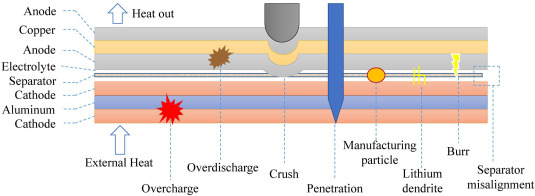
Source: Battery University

The separator is thin because low internal resistance, compact construction, and high energy density all matter. That thinness makes quality control critical. A microscopic metal particle can remain harmless for some time and later form a conductive bridge under cycling, vibration, pressure, thermal expansion, or local chemical change.
Clean rooms, improved raw-material control, automated assembly, and reduced human handling have lowered the rate of early cell failures. These controls are especially important for lithium-ion cells because a rare internal short can be a major safety event. The concern is not only loss of capacity; it is the possibility of localized heating inside a sealed electrochemical device. If heat generation exceeds the cell design’s ability to dissipate or interrupt the fault, the event can escalate.
Internal shorts should be distinguished from external shorts. An external short occurs outside the cell or pack, such as a tool bridging terminals or a wiring fault. An internal short occurs within the cell structure itself. External faults can often be interrupted by fuses, current limits, protection electronics, or contactors. Internal faults are more difficult because the unwanted current path may exist behind the protective boundary.
Why High-Current Bursts Are Only a Limited Nickel-Cell Remedy
Nickel-cadmium and nickel-metal-hydride cells have historically been subjected to brief high-current pulses in attempts to clear soft shorts. The idea is simple: if the short is caused by a small conductive filament or localized bridge, a short burst of current may heat and burn away that bridge, temporarily restoring normal terminal voltage.
This practice belongs to a narrow historical context. It does not convert a damaged cell into a new cell, and it does not remove the underlying aging or manufacturing condition that allowed the short to develop. Even if terminal voltage appears to recover, the cell may continue to show excessive leakage, poor capacity, elevated self-discharge, or repeated failure.
There are several reasons the method is unreliable:
- The fault path may not be a small removable filament.
- The separator may already be mechanically damaged.
- The cell may have multiple weak points rather than one soft short.
- Heat from the pulse can create additional internal damage.
- The apparent repair may disappear after rest, charge, discharge, or vibration.
For engineering maintenance, a pulsed recovery should be treated as a temporary intervention, not a verified repair. It may have been used in service shops or hobby settings for some nickel-based cells, but it is not a general battery-reconditioning method. Any cell that has shorted has already demonstrated abnormal behavior and should be evaluated conservatively.
Replacing a Shorted Cell in an Aging Pack
Replacing one shorted cell in an old battery pack seems economical, but it often creates a pack with mismatched cells. Battery packs depend on series and parallel groups behaving predictably as a system. When one cell has failed, the rest of the pack may also be aged, imbalanced, or near the end of useful life.
The replacement cell may differ from the remaining cells in:
- capacity,
- internal resistance,
- self-discharge rate,
- state of health,
- state of charge,
- temperature response,
- cycle history,
- and protection or venting characteristics.
In a series string, the weakest cell often determines usable pack capacity. A new cell placed among older cells may not solve the system problem; it may simply move stress to another weak cell. During charging, an aged low-capacity cell can reach its voltage limit earlier than the new cell. During discharge, an aged cell can reach its lower limit earlier. Without proper balancing and pack-level validation, the repaired pack can remain unreliable or unsafe.
This is especially important for lithium-ion packs. Many consumer and industrial lithium-ion packs are welded, monitored, and protected as integrated assemblies. Replacing individual cells can disturb welds, insulation, compression, sensing wires, thermal paths, and battery management system calibration. In safety-critical equipment, transportation, medical devices, energy storage, or high-power tools, pack-level evaluation or replacement is usually safer than user-level cell swapping.
For nickel-based packs, individual cell replacement may be more feasible in some service contexts, but the same matching problem remains. A repaired pack should not be assumed equivalent to a new pack unless it has been tested under the conditions for which it will be used.
Which Battery Chemistries Are More Likely to Develop Shorts
Different chemistries and cell constructions show different tendencies for leakage, shorts, and safety consequences. The reference source notes that cobalt-blended lithium-ion cells generally develop fewer leakage and electrical-short issues than nickel- and lead-based batteries, while still acknowledging that shorts can occur in lithium-ion cells. That distinction matters: lower frequency does not mean lower consequence.
Nickel-based cells can develop shorts from separator degradation, dendritic growth, contamination, or aging effects. Lead-based batteries can suffer from sediment accumulation, separator failure, plate shedding, mechanical damage, or manufacturing defects that eventually create conductive paths. Their failure modes are often more tolerant than high-energy lithium-ion failures, but they can still produce heat, gas, venting, and loss of function.
Lithium-ion cells cover several chemistries and formats. Cobalt-blended chemistries have high energy density and are widely used in portable electronics and other compact applications. Lithium iron phosphate cells are often selected for improved thermal stability and long cycle life in many applications, but they are not immune to internal shorts. Manufacturing defects, physical abuse, overcharge, freezing-temperature charging, or separator damage can still create internal failure paths.
The reference source also observes that, in series strings, the cell at the positive end may be more likely to short first. This should be treated as an observed tendency rather than a fully settled mechanism. Possible contributors could include electrical stress, pack layout, thermal gradients, mechanical constraints, or how end cells experience environmental exposure, but a specific cause should not be assumed without pack-specific evidence.
The practical conclusion is chemistry-specific but conservative: evaluate both probability and consequence. A chemistry that rarely develops shorts can still require strong protection if the consequences of a short are severe.
Lithium-Ion Shorts, Protection Limits, and Safer Design Choices
Lithium-ion packs require particular care because the stored energy, flammable electrolyte systems, and possible thermal-runaway pathway make internal shorts a high-consequence fault. An internal short caused by contamination or cell damage is different from a normal overload or an external short at the pack terminals. Protection electronics may detect and interrupt many external or operating-condition faults, but they may not be able to remove a conductive path that has formed inside a cell.
Good lithium-ion safety design therefore combines prevention, detection, containment, and conservative service decisions. No single feature should be treated as complete protection.
What Protection Circuits Can and Cannot Prevent
Lithium-ion protection electronics commonly guard against conditions such as overvoltage, undervoltage, overcurrent, excessive loading, reverse polarity risks in some pack contexts, and sometimes temperature faults, depending on the pack design. A battery management system may also monitor cell-group voltage balance, current, pack temperature, and charge or discharge limits.
These protections are essential, but they have boundaries. If a short begins inside a damaged or contaminated cell, the protection circuit may not be able to stop the local internal current. It can disconnect the pack from the load or charger, but the fault path may already be within the cell. That is why internal shorts are considered difficult safety faults.
Conditions associated with lithium-ion cell damage include:
- mechanical shock,
- vibration,
- crushing or puncture,
- overcharge,
- overheating,
- charging below freezing,
- and previous abuse that leaves no obvious external sign.
Charging at freezing temperatures is particularly deceptive because the user may not see immediate stress. The cell may later show abnormal behavior because lithium plating or other damage mechanisms have reduced safety margin.
Two well-known examples illustrate why protection alone is not enough. The 2006 Sony-related lithium-ion battery recalls were associated with microscopic metal particles that could contribute to internal shorting in notebook computer batteries. The Boeing 787 battery incidents led to a redesign of the aircraft battery system after in-service failures involving lithium-ion battery overheating. These examples should not be generalized beyond their documented contexts, but they show the same engineering lesson: certified systems still need layered safety design because internal cell faults can bypass ordinary electronic safeguards.
Separators, Detection, and Energy-Density Tradeoffs
Cell and pack designers use several methods to reduce or manage internal-short risk. Separator design is one of the most important. Options include mechanically tougher separators, ceramic-coated separators, and shutdown separators intended to reduce ion transport when temperature rises. Some cells also include current interrupt devices or pressure-activated mechanisms intended to reduce fault energy under specified abuse conditions.
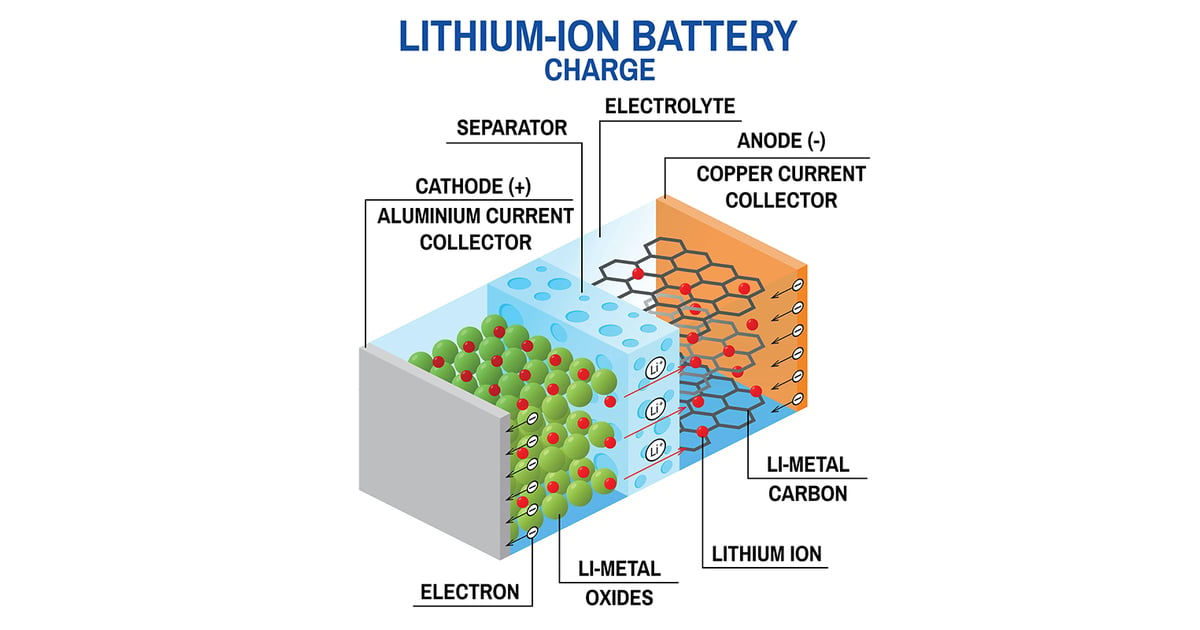
Source: Battery University

Mechanical robustness also matters. Electrode alignment, tab design, winding or stacking control, edge insulation, compression management, and enclosure strength all influence how a cell responds to vibration, swelling, impact, and thermal cycling. At the pack level, spacing, insulation, thermal barriers, vent paths, and fault containment can reduce propagation if one cell fails.
These choices involve tradeoffs. Heavier-duty separators, added insulation, stronger enclosures, more spacing, and additional sensing can increase size, weight, cost, and complexity. They may also reduce the amount of active material that fits into a given volume. In other words, higher safety margin can reduce energy density. The right balance depends on application: a phone, power tool, electric vehicle, aircraft battery, and stationary storage rack do not have the same tolerance for weight, cost, serviceability, or failure consequence.
Detection is another challenge. Once cells are assembled into series and parallel groups, an internal short in one cell can be difficult to distinguish from normal variation, imbalance, aging, or measurement noise. Possible indicators include:
- abnormal self-discharge,
- unusual voltage relaxation after charge or discharge,
- persistent cell-group imbalance,
- localized temperature rise,
- swelling or increased pressure,
- gas generation,
- unexpected capacity loss,
- or BMS fault trends that repeat under similar conditions.
These signs do not prove an internal short by themselves, and absence of visible signs does not prove safety. Professional diagnostics may use voltage tracking, relaxation analysis, temperature monitoring, impedance-related measurements, gas or swelling observations, and pack-history data. For users, the safe response to a suspect lithium-ion pack is not exploratory repair; it is to stop using the pack, prevent charging, isolate it from combustible materials where practical, and follow manufacturer or qualified-service guidance.
Never Use High-Current Bursts on Lithium-Ion Cells
High-current pulse methods sometimes associated with nickel-based cell revival must not be used on lithium-ion cells. A lithium-ion cell with a suspected internal short is already in an abnormal condition. Forcing high current through it can increase internal heat generation, accelerate separator damage, intensify gas generation, and raise the risk of fire or thermal runaway.
A shorted lithium-ion cell should not be treated as a candidate for reconditioning. It should be treated as a safety risk. Do not attempt to burn away the short, weld directly to unknown cells, bypass protection electronics, recharge a cell that will not hold voltage, or continue using a pack that becomes hot, swollen, odorous, noisy, or unstable.
Safety note: if a lithium-ion battery is suspected of having an internal short, stop using it and do not charge it. Follow the equipment maker’s instructions, use qualified service channels when repair is appropriate, and send failed batteries to proper recycling or hazardous-waste handling channels rather than ordinary trash.
References
- Battery University | BU-803b: What causes Cells to Short?. (n.d.). http://www.batteryuniversity.com/article/bu-803b-what-causes-cells-to-short
- Battery University (@batteryuniversity). (n.d.). https://www.facebook.com/batteryuniversity
- Cell Internal Short Circuits - Battery Design. (n.d.). https://www.batterydesign.net/cell-internal-short-circuits
- Telomere Shortening: Root Causes, Labs, and Functional .... (n.d.). https://lamkinclinic.com/telomere-shortening
- What causes uncontrolled cell division?. (n.d.). https://synapse.patsnap.com/article/what-causes-uncontrolled-cell-division
- What Happens When a Battery Short Circuits? Safety Guide – LiTime. (n.d.). https://www.litime.com/blogs/troubleshooting/battery-short-circuits
- Why Do Telomeres Shorten When a Cell Divides, and How Does It Affect Human Aging?. (n.d.). https://news.cuanschutz.edu/news-stories/why-do-telomeres-shorten-when-a-cell-divides-and-how-does-it-affect-human-aging
- What Causes Internal Short Circuits in Lithium Batteries. (n.d.). https://www.large-battery.com/blog/causes-internal-short-circuits-lithium-batteries
- Novel Short-Circuit Detection in Li-ion Battery Architectures. (n.d.). https://inldigitallibrary.inl.gov/sites/sti/sti/Sort_1809.pdf
- Battery Failure Analysis: Lithium-Ion Modes&Diagnostic Guide. (n.d.). https://iestbattery.com/case/lithium-ion-battery-failure-analysis