An older lithium-ion battery can create a confusing charging symptom: it may no longer run a device for as long as it once did, yet it still seems to take a long time to reach “full.” Intuitively, a smaller remaining capacity should fill faster. In practice, aged Li-ion cells often spend more time in the slow, voltage-limited part of the charge cycle.
The effect is not simply a matter of the charger being weak or the battery gauge being inaccurate. It is closely tied to how Li-ion charging works. A typical Li-ion charge profile uses a full-current phase until the cell reaches its voltage ceiling, followed by a constant-voltage phase in which current gradually tapers. As the cell ages, it may reach the voltage limit earlier while accepting less charge, then remain in the taper region for a comparatively long time.
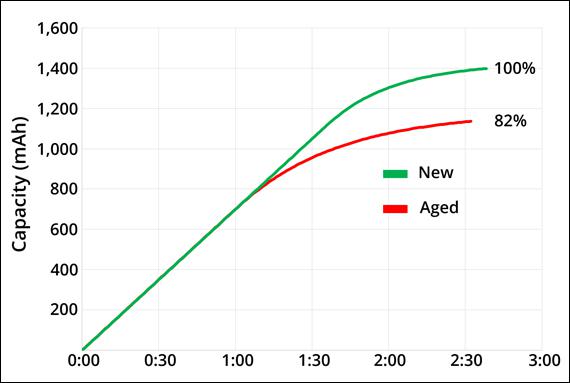
In the reference example, a new Li-ion pack and an aged pack both take roughly 150 minutes to charge. The difference is that the new pack reaches about 1,400mAh, treated as 100 percent capacity, while the aged pack reaches only about 1,150mAh, or about 82 percent. The same clock time therefore does not mean the same delivered energy.
Why an Older Li-ion Battery May Not Charge Faster
The apparent paradox comes from confusing charge time with charge accepted. A new cell can remain in the high-current part of the charge process longer and store more capacity before it reaches the upper voltage limit. An aged cell may reach that limit earlier even though it has accepted less charge.
A simplified comparison is:
| Battery condition | Example accepted capacity | Relative capacity | Approximate total charge time |
|---|---|---|---|
| New Li-ion pack | 1,400mAh | 100% | 150 minutes |
| Aged Li-ion pack | 1,150mAh | 82% | 150 minutes |
This does not imply that the old battery has somehow become equally useful after charging. It only means the charger spent a similar amount of time moving through its control sequence. The aged pack stores less usable capacity at the end of that sequence.
For a user, the symptom can look like this:
- The device reaches a full-charge indication after a long wait.
- Runtime is noticeably shorter than when the battery was new.
- The final part of charging appears slow or “stuck.”
- Replacing the charger may not change the behavior if the battery itself is the limiting element.
The root cause is that the cell’s electrochemical condition has changed. With age and use, a Li-ion battery loses capacity and can also lose some ability to accept charge efficiently. The charger still follows voltage and current limits, but the aged cell responds differently to the same charging command.
Source: Battery University

Stage 1: Reaching the Voltage Limit Sooner
The first part of a conventional Li-ion charge is the constant-current stage. In this stage, the charger supplies a regulated current and the cell voltage rises. For many conventional Li-ion cells, the upper charge-voltage limit is around 4.20V per cell. Once the cell reaches that limit, the charger can no longer continue pushing the same full current without exceeding the voltage ceiling.
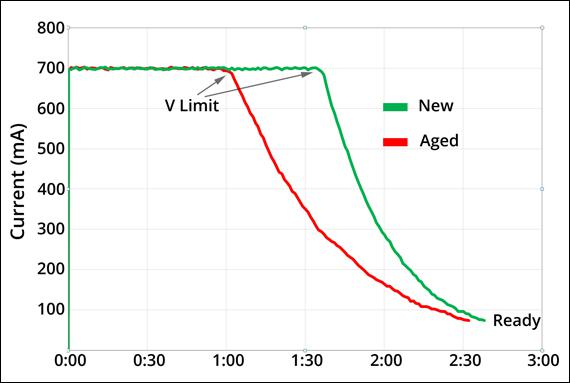
In the reference comparison, the new Li-ion pack remains in full-current charge for about 90 minutes. The aged cell reaches the 4.20V/cell voltage limit after only about 60 minutes. The older battery therefore exits the fast portion of the charge earlier, even though it has not accepted as much capacity.
This behavior is easier to understand if terminal voltage is treated as a response, not a direct fuel gauge. When charging a Li-ion cell, the voltage can rise quickly, similar to pulling on a weight through a rubber band. The force at the end of the rubber band increases before the whole system has fully moved. In a battery, the measured terminal voltage can climb toward the limit even while the internal charge-storage process has not caught up proportionally.
The analogy is imperfect, but it captures the important charging observation: an aged cell can show a high terminal voltage before it has accepted much energy. That early voltage rise forces the charger to reduce current sooner.
A practical way to view Stage 1 is:
- The charger applies full regulated current.
- Cell voltage rises toward the upper limit.
- A healthy cell can accept charge for longer before reaching the limit.
- An aged cell reaches the limit sooner.
- The charger must transition out of full-current charging even though the aged cell has stored less capacity.
Aging is associated with reduced charge-transfer capability. In plain terms, the cell becomes less able to accept incoming charge at the same rate. The charger may be capable of delivering current, but the cell’s voltage response tells the charger to stop pushing at that level.
This is why a short Stage 1 does not necessarily mean the charge process is efficient. For an old battery, a short full-current stage can be a sign that the cell is voltage-limited early rather than quickly filled.
Stage 2: Longer Saturation and Current Taper
After the cell reaches the voltage limit, the charger enters Stage 2, the constant-voltage or saturation stage. In this phase, the charger holds the cell at the voltage ceiling and allows current to taper downward. Charge continues to enter the cell, but the rate becomes progressively lower.
This taper is a normal part of Li-ion charging. It is one reason the last part of charging takes disproportionately long compared with the earlier full-current stage. A charger may declare charge complete when current has fallen to a defined threshold. In the reference example, ready mode may be triggered when current trails down to about 0.05C, depending on charger design.
The important aging effect is that the taper can become prolonged. A healthy battery tends to have a shorter current trail. An aged battery can spend more time in this voltage-limited saturation region, with current declining slowly.
Source: Battery University

The result is a charge cycle that feels slow in the final stretch:
- The battery voltage has already reached the limit.
- The charger cannot increase voltage to speed the process.
- Current is reduced to stay within the voltage limit.
- The aged cell accepts the remaining charge slowly.
- The charge indicator may remain near the top of the scale for a long time.
This explains how an aged pack can take roughly as long to charge as a new one while storing less total energy. It does not spend that time accepting the same amount of charge. Instead, it reaches the voltage ceiling early and then spends a relatively long period in low-current saturation.
Passive material buildup associated with aging is one reason charge-transfer capability can decline. As the cell ages, internal changes can make it harder for charge to move through the electrochemical system. The charger sees this indirectly through the voltage and current behavior: voltage rises early, and current taper takes longer.
A useful comparison is between two time profiles rather than two fuel tanks. A new battery has more useful capacity and can accept full-current charge for longer before tapering. An aged battery has less capacity but can still require a long controlled finish because the limiting factor has shifted from “how much room is left” to “how well the cell can accept charge near the voltage limit.”
This also explains why forcing more current is not a proper cure. Once the cell reaches its voltage limit, the charger must respect that limit. A well-designed Li-ion charger controls voltage and current to avoid overcharge. The slow taper is part of the safe charging method, not merely wasted time.
What Charge Time Reveals About Battery Health
Charging behavior can provide useful clues about battery health, but it should be interpreted carefully. A long charge time by itself is not a complete diagnosis. It becomes more meaningful when combined with capacity, voltage behavior, current taper, and runtime.
The reference identifies three important battery-health attributes:
- Capacity — how much charge the battery can store compared with when it was new.
- Internal resistance — how strongly the battery resists current flow under charge or discharge.
- Self-discharge — how quickly the battery loses charge when not powering a load.
Capacity is often the most visible sign of aging because users notice shorter runtime. In the example, the aged pack charges to about 82 percent of the new pack’s capacity. That reduced capacity is the practical reason the device runs for less time after charging.
However, charging behavior reveals additional information. Two signs are especially relevant:
- Early voltage rise — the cell reaches the voltage limit sooner during the constant-current stage.
- Long saturation time — the cell spends more time in the constant-voltage taper stage before the charger declares completion.
Together, these symptoms suggest that the aged battery is not accepting charge the way a new one does. They do not automatically prove that the charger is defective. In many cases, the charger is simply responding correctly to the aged cell’s voltage and current behavior.
Battery management systems and diagnostic algorithms can use this type of information to estimate battery condition. By observing voltage, current, time, and delivered capacity, a system can infer changes in the battery’s internal state. For example, it can compare how long the cell remains in constant-current charging, how quickly current tapers in constant-voltage charging, and how much capacity is delivered by the end of the cycle.
For practical troubleshooting, the distinction matters. If an old Li-ion pack charges for a long time but delivers poor runtime, the limiting factor is likely the battery’s aged condition rather than the amount of time it spent connected to the charger. The battery may still reach the charger’s full indication, but “full” now represents a smaller usable capacity.
A concise diagnostic interpretation is:
| Observation | Likely meaning |
|---|---|
| Full charge takes about as long as before | Charger timing alone does not indicate retained capacity |
| Runtime is shorter | Capacity has likely declined |
| Voltage limit is reached early | The cell may no longer accept full-current charge for as long |
| Final charging stage is slow | Current taper and saturation time may be prolonged |
| More time on charger gives little benefit | The cell is voltage-limited and accepting only small taper current |
The engineering lesson is that aged Li-ion charging is controlled less by the empty capacity remaining and more by the cell’s ability to accept charge within voltage limits. An old battery may have less to fill, but it can still take a long time to complete because the slow part of the charge profile has become a larger share of the total cycle.
References
- Battery University | BU-409a: Why do Old Li-ion Batteries Take Long…. (n.d.). https://www.batteryuniversity.com/article/bu-409a-why-do-old-li-ion-batteries-take-long-to-charge
- Battery University | BU-409a: Why do Old Li-ion Batteries Take Long…. (n.d.). http://www.batteryuniversity.com/article/bu-409a-why-do-old-li-ion-batteries-take-long-to-charge
- Why Charging Old Li-ion Batteries Takes More Time. (n.d.). https://www.large-battery.com/blog/why-do-old-li-ion-batteries-take-long-to-charge-explained
- BU-808: How to Prolong Lithium-based Batteries. (n.d.). http://www.batteryuniversity.com/article/bu-808-how-to-prolong-lithium-based-batteries
- Why Old Batteries (lower capacity) Charge Still Slowly. (n.d.). https://www.grepow.com/blog/why-does-the-charging-time-of-old-batteries-lower-capacity-not-become-shorter-battery-monday.html
- BU-801b: How to Define Battery Life. (n.d.). https://www.batteryuniversity.com/article/bu-801b-how-to-define-battery-life
- Why does the last 20% of a battery take longer to charge than the rest?. (n.d.). https://www.quora.com/Why-does-the-last-20-of-a-battery-take-longer-to-charge-than-the-rest
- Very slow charge of a Li-Ion battery can be a problem?. (n.d.). https://www.electro-tech-online.com/threads/very-slow-charge-of-a-li-ion-battery-can-be-a-problem.128721
- Why does keeping lithium-ion batteries at a 100% charge damage .... (n.d.). https://www.reddit.com/r/batteries/comments/1bpvv4y/why_does_keeping_lithiumion_batteries_at_a_100
- Why do old batteries take the same amount of time to charge. (n.d.). https://electronics.stackexchange.com/questions/306876/why-do-old-batteries-take-the-same-amount-of-time-to-charge