Sodium-based molten-salt batteries occupy an unusual place in battery engineering. Unlike lead-acid, lithium-ion, or nickel-based cells, many established sodium chemistries are designed to run hot. Heating is not simply a way to improve performance; in conventional sodium-sulfur and sodium-nickel-chloride systems it is part of the electrochemical design.
The reason is physical as much as chemical. Sodium, sulfur, sodium polysulfides, and molten salts must be in the correct phase and in good contact with an ion-conducting separator. At low temperature, the same cell materials may become poorly conductive, mechanically mismatched, or effectively inactive. This is why high-temperature sodium batteries are often described as molten-salt or thermal batteries.
Historically, molten-salt battery concepts were developed for applications where long storage and rapid activation mattered more than everyday convenience. Early work is associated with Germany during World War II and V-2 rocket applications. Later rechargeable versions, especially sodium-sulfur batteries developed for stationary energy storage and sodium-nickel-chloride ZEBRA batteries, shifted the technology toward grid storage, electric vehicles, industrial equipment, and backup power.
What Sodium Molten-Salt Batteries Are
A sodium molten-salt battery is a battery system in which sodium is one of the active materials and ion conduction depends on a high-temperature electrolyte or solid ion conductor. These batteries are often grouped with thermal batteries because they need heat before they can deliver useful power.
There are two broad categories:
- Primary thermal batteries: one-shot batteries intended for a single activation and discharge event. When cold, the electrolyte is inactive, which allows very long storage. Once heated by an internal or external heat source, the electrolyte becomes conductive and the battery can provide power for a short burst or for a limited mission duration.
- Secondary sodium batteries: rechargeable systems such as sodium-sulfur and sodium-nickel-chloride batteries. These are not one-shot devices, but they still need elevated temperature to operate correctly.
In a cold primary thermal battery, the inactive electrolyte is an advantage. It suppresses unwanted reactions during storage and can allow extremely long shelf life. That characteristic made thermal batteries attractive for military and aerospace-type uses where a battery might sit unused for years and then be required to deliver power immediately after activation.
Rechargeable sodium molten-salt batteries face a different design problem. They must remain hot during operation, and they must be heated before use if they have cooled. This makes them less convenient than room-temperature batteries, but it can be acceptable in fixed installations or fleet applications where the battery operates regularly and thermal management can be engineered into the system.
Why Sodium-Sulfur Batteries Need Heat
A conventional sodium-sulfur battery uses molten sodium as the negative electrode and sulfur or sodium polysulfides on the positive side. The two electrodes are separated by a solid ceramic electrolyte, commonly described as beta-alumina solid electrolyte, that conducts sodium ions while blocking direct electronic conduction.
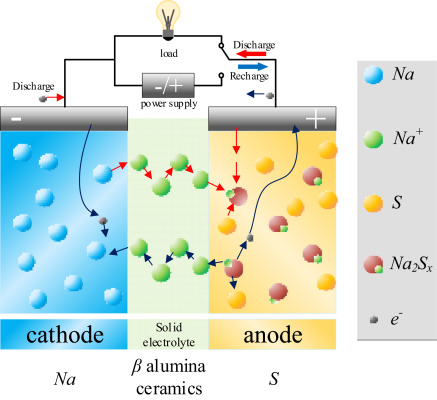
Source: Original source

The battery needs heat for several linked reasons:
- The active materials must be molten. Sodium melts at about 98°C and sulfur at about 119°C, but practical sodium-sulfur batteries operate well above these melting points to maintain good electrochemical contact and ionic transport.
- The ceramic electrolyte needs sufficient sodium-ion conductivity. Beta-alumina conducts sodium ions much better at elevated temperature. Below the required range, too few sodium ions migrate through the separator to support normal power.
- Electrode wetting and contact matter. Molten electrodes can wet the electrolyte and maintain intimate contact. If materials solidify or become too viscous, contact deteriorates and internal resistance rises.
- Power capability depends on temperature. High-temperature operation reduces transport limitations that would otherwise restrict current output.
Older thermal battery designs are described as operating around 400–700°C. Newer sodium-based molten-salt designs generally operate at lower, but still high, temperatures. Conventional rechargeable sodium-sulfur systems commonly operate roughly in the 300–350°C region, with broader modern sodium molten-salt designs often cited around 245–350°C depending on chemistry and construction.
Below the required operating temperature, the battery does not simply become a slightly weaker version of itself. Ionic transport falls, electrode/electrolyte contact worsens, and wetting may fail. If the sodium and sulfur phases are not in the intended molten condition, the cell cannot deliver normal power or efficiency.
This is why a sodium-sulfur battery must be preheated before operation unless it is already hot from continuous service. Once running, heat generated during charge and discharge can help maintain temperature, but insulation and thermal controls are still required.
Rechargeable Sodium-Sulfur Batteries and Grid Storage
Rechargeable sodium-sulfur batteries were developed significantly during the 1970s and 1980s as engineers looked for high-energy rechargeable systems based on abundant active materials. Sodium and sulfur are attractive from a materials standpoint, and the chemistry can provide relatively high energy density compared with many older aqueous battery systems.
The practical market that emerged most naturally was stationary energy storage, especially load leveling and grid storage. In these applications, the disadvantages of high operating temperature are easier to manage than they would be in handheld electronics or casually used passenger vehicles.
Stationary installations can justify:
- dedicated insulation and heaters;
- monitored enclosures;
- fire and fault-management systems;
- controlled duty cycles;
- scheduled maintenance;
- operation that keeps the battery hot for long periods.
For grid storage, a sodium-sulfur battery may be charged when generation exceeds demand and discharged when demand rises or renewable output falls. The battery is not expected to sit cold in a drawer or start instantly like a consumer battery. Instead, it is part of an engineered plant.
The same thermal requirement that makes NaS batteries difficult for intermittent personal use can be less problematic in fixed service. If the system cycles regularly, the energy spent keeping it hot becomes part of the operating model. If it sits unused for long periods while hot, however, the parasitic heat loss becomes costly.
The main engineering constraints are therefore not only electrochemical. They include preheating time, insulation performance, thermal gradients, ceramic separator integrity, containment of reactive molten sodium and sulfur, and controls that prevent unsafe operation outside the intended temperature window.
ZEBRA Sodium-Nickel-Chloride Batteries
ZEBRA batteries are rechargeable sodium-nickel-chloride batteries, also written as Na-NiCl₂ batteries. They are related to sodium-sulfur batteries because they also use molten sodium and a sodium-ion-conducting ceramic electrolyte, but their positive electrode chemistry is different.
The ZEBRA name is historically associated with “Zero Emission Battery Research Activities.” In practical battery terminology, it refers to a high-temperature sodium-nickel-chloride molten-salt battery.
ZEBRA batteries typically operate at about 270–350°C, a lower high-temperature range than many earlier sodium-sulfur or primary thermal-battery designs. A commonly cited nominal cell voltage for the Na-NiCl₂ chemistry is about 2.58 V. Exact pack-level energy density depends on cell design, insulation, container construction, and system hardware, so it should not be treated as a single universal number.
Compared with lead-acid, nickel-based, and lithium-ion batteries, ZEBRA batteries have a distinctive tradeoff:
| Characteristic | ZEBRA sodium-nickel-chloride | Lead-acid / nickel-based / lithium-ion context |
|---|---|---|
| Normal operating temperature | High, typically hundreds of degrees Celsius | Usually designed for much lower temperatures |
| Storage when cold | Can be inactive but needs reheating before use | Generally available without long preheating |
| Continuous-use suitability | Better when kept hot and cycled regularly | Often better for intermittent use |
| High ambient temperature tolerance | Can be favorable because the cell is already hot | Many room-temperature batteries need cooling or derating |
| Main service burden | Heating, insulation, thermal control | Aging, cooling, charge control, or maintenance depending on chemistry |
ZEBRA batteries have been considered or used in electric vehicles and fleet-style applications. The Think City electric vehicle, for example, was associated with both ZEBRA and lithium-ion battery options. The ZEBRA approach can be more practical in taxis, delivery vans, and other vehicles that operate frequently because continuous use reduces the penalty of maintaining a hot battery pack.
For a privately owned vehicle that may sit parked for days, the heating requirement is a larger disadvantage. Energy must be consumed to keep the pack hot, or the driver must wait for reheating before use.
Where ZEBRA Performs Well
ZEBRA batteries perform best where their thermal operating mode is not a major inconvenience. Suitable applications are those where the battery can remain hot and in regular service, or where the installation can tolerate warm-up time.
Examples include:
- electric fleet vehicles;
- taxis and delivery vans;
- industrial vehicles and equipment;
- backup power systems;
- telecom power systems;
- rail support and traction-related uses;
- stationary storage and load-leveling installations.
A notable advantage is tolerance of high ambient temperature. Many lithium-ion systems must be cooled or derated in hot environments to protect lifetime and safety. A ZEBRA battery already operates at a much higher internal temperature, so hot ambient conditions may be less of an operating shock, provided the insulation and control system are designed correctly.
That does not mean ZEBRA batteries are thermally simple. They still need controlled heating, insulation, temperature monitoring, and protection against abnormal operation. Their advantage is narrower: they can be practical in applications where staying hot is part of normal service.
The less frequently the battery is used, the harder it is to justify. If the pack is allowed to cool, it cannot immediately deliver full power. If it is kept hot while unused, it consumes energy just to remain ready.
Heating Losses, Self-Discharge, and Safety Tradeoffs
Insulation reduces heat loss but does not eliminate it. A hot battery in a cooler environment continuously loses heat through its enclosure, terminals, supports, and service interfaces. That heat must be replaced by energy from an external supply or from the battery itself.
For ZEBRA batteries, the reference case commonly cited by Battery University gives a useful sense of scale: heating may consume about 14 percent of the battery’s energy per day. Because this energy is taken from the battery when the system is unplugged, the resulting effective parasitic load or self-discharge is cited at about 18 percent per day in that context.
This is not the same mechanism as chemical self-discharge in a room-temperature cell. Much of the loss is thermal housekeeping. The battery is spending stored energy to remain within its operating temperature range.
The practical consequences are significant:
- A parked unplugged battery can lose usable energy quickly.
- Long standby periods reduce system efficiency.
- Continuous operation improves the economics of keeping the battery hot.
- Thermal insulation becomes a core part of battery performance, not just packaging.
Safety tradeoffs also differ between sodium-sulfur and sodium-nickel-chloride systems. ZEBRA batteries are generally considered less violent in some failure scenarios than molten sodium-sulfur batteries because the chemistry and reaction products differ. However, they are still high-temperature sodium batteries and must be treated as such.
Important failure modes include:
- Ceramic electrolyte failure: cracking or breach can allow materials to contact in unintended ways.
- Loss of insulation: increased heat loss can drain the battery or create uneven temperature distribution.
- Cooling below operating temperature: the cell may lose normal conductivity and power capability.
- Thermal-management faults: heater, sensor, or control failures can push the battery outside its safe operating window.
- Containment failure: reactive sodium and hot internal materials require robust enclosure design.
A ZEBRA pack therefore needs more than electrical battery management. It needs thermal management, mechanical containment, fault isolation, and procedures for startup, shutdown, and storage.
Lower-Temperature and Room-Temperature Sodium-Sulfur Research
The need for heat is one of the main reasons researchers continue to investigate lower-temperature and room-temperature sodium-sulfur batteries. If the chemistry could operate reliably without maintaining a battery near 300°C, it could reduce energy loss, simplify packaging, lower safety risk, and expand possible applications.
The challenge is that temperature is not an incidental parameter in established molten sodium-sulfur batteries. It enables the physical state and ion transport that make the battery work.
When the operating temperature is reduced, several problems become harder:
- Solid interfaces replace molten contact. Solid sodium, sulfur, or discharge products do not wet the electrolyte as easily as molten phases.
- Ion mobility falls. Lower temperature generally reduces ionic transport through electrolytes and interfaces.
- Polysulfide shuttling can reduce efficiency. Soluble sulfur species can migrate in unwanted ways in some room-temperature designs.
- Sodium dendrites may form. Metallic sodium can deposit unevenly, creating safety and lifetime risks.
- Cycle life becomes difficult to maintain. Laboratory performance does not automatically translate into durable large-format batteries.
Some research directions use new electrolytes, separators, catalysts, host structures for sulfur, or protective layers for sodium metal. These approaches aim to reproduce the useful transport and reaction behavior of high-temperature systems without requiring molten electrodes.
Room-temperature sodium-sulfur batteries should therefore be viewed as an active development area, not a direct mature replacement for conventional high-temperature NaS systems. The promise is real: sodium and sulfur remain attractive materials for large-scale storage. But established molten sodium-sulfur batteries need heat because their working principle depends on molten active materials, sodium-ion conduction through a ceramic electrolyte, and stable high-temperature interfaces.
That is the central engineering answer: sodium-sulfur batteries are heated because, in the conventional design, heat is what turns the cell materials into a functioning electrochemical system rather than an assembly of poorly conducting solids.
References
- Battery University | BU-210a: Why does Sodium-sulfur need to be heated
- Sodium–sulfur battery - Wikipedia
- Fresh Opportunity for the Sodium–Sulfur Battery
- Research on Wide-Temperature Rechargeable Sodium-Sulfur Batteries: Features, Challenges and Solutions - PMC
- [FREE] What happens when sodium and sulfur combine? - brainly.com
- Sodium Sulfur Battery Temperature Threshold Vs Lithium-Ion
- Sodium-Sulphur - an overview | ScienceDirect Topics
- Sodium Sulfur Batteries
- Sodium Sulfur Batteries - an overview
- High performance sodium-sulfur batteries at low …